
If you use these results, please cite the paper they build on: Hall MB, et al. Benchmarking reveals superiority of deep learning variant callers on bacterial nanopore sequence data. eLife 13:RP98300 (2024). doi:10.7554/eLife.98300
TL;DR#
I reran our bacterial nanopore variant calling benchmark [1]
with a couple of updated tools. I then compared the paper’s best caller, Clair3
[2] with ONT’s
dorado polish.
- SNPs: Clair3, run in (default) diploid mode, with an allele frequency (AF) filter in place of
--haploid_precise, had the highest median SNP F1 score at every depth with both read models. With sup reads its lead over Dorado grows from 25x up: at 50x it made 23 SNP errors over the 14 genomes, against Dorado’s 83. - Clair3 with the paper’s settings vs Dorado: Dorado calls SNPs better at 5x and 10x, predominantly via improved recall. The two are level at 25x, and Clair3 is slightly ahead at 50x.
- Indels: Clair3 is better at nearly every depth. At 50x its median F1 is 0.990 against Dorado’s 0.978 for hac, and 0.995 against 0.990 for sup.
- Default filters: Dorado’s
PASSfilter lets too much through at low depth. Its QUAL scores sort good calls from bad well, so filtering on QUAL fixes most of this. - Speed: Dorado takes about 5 seconds for a 50x bacterial genome on an H100 GPU. On CPU it takes about a minute, as Clair3 does, but needs about 10 GB of RAM.
In practice, at 50x either tool will give you nearly the same SNPs, with fewer than ten errors per genome. If you want the best you can get, down to single SNPs, use Clair3 with the AF filter.
Background#
In our eLife paper [1] we benchmarked variant callers on ONT reads from 14 bacterial species, using truth sets made by mutating each sample’s own reference genome. We found Clair3 came out on top, but three things have changed since:
- ONT now offers
dorado polishwith--vcfas a way to call variants against a haploid reference. Its--bacteriamodel was trained for polishing bacterial assemblies. - Clair3 is now at version 2 (PyTorch), and minimap2 [3]
has a new
lr:hqpreset, which did slightly better for variant calling in my earlier post. - In his Dorado v2 polishing post, Ryan Wick suggested a more controlled way to
polish: run
dorado polishwith--vcf, filter the proposed changes, and apply only the high-confidence ones. That works only if the bad changes can be told apart, by quality score, depth or something else. Ryan and I then talked about me rerunning the paper’s benchmark to see how Dorado does as a variant caller, and this post is the result. Thanks to Ryan for getting it started.
So the question for this post is:
How does
dorado polish --bacteria --vcfcompare with Clair3 for bacterial variant calling, and what does it cost to run?
Methods#
The workflow lives in the paper’s NanoVarBench repository. The variant calls and vcfdist outputs are on Zenodo.
Data#
All 14 samples (species) from the paper. I used the hac and sup simplex reads, basecalled with Dorado v4.3.0, that we deposited in the SRA1, and the truth sets on Zenodo. Reads were filtered to ≥1,000 bp and Q≥10.
Depth#
Reads were subsampled to 5, 10, 25 and 50x with rasusa aln
[4]. It caps the depth at each position by taking a random
selection of the reads there, which stops high-copy plasmids from using up the read budget
and gives more even coverage than the paper’s genome-wide subsampling2.
Variant calling#
I compared four arms:
| Arm | Aligner | Caller | Model |
|---|---|---|---|
| A (paper) | minimap2 2.26 map-ont | Clair3 1.0.5 | v4.3.0 hac/sup |
B (lr:hq post) | minimap2 2.31 lr:hq | Clair3 1.0.5 | v4.3.0 hac/sup |
| C (current Clair3) | minimap2 2.31 lr:hq | Clair3 2.0.3 | v4.3.0 hac/sup, converted to PyTorch |
| D (Dorado) | minimap2 2.31 lr:hq | dorado polish 2.1.2 | --bacteria |
Clair3 ran with the paper’s options (--haploid_precise --include_all_ctgs --no_phasing_for_fa --enable_long_indel). Dorado ran with --bacteria --vcf --min-depth 2, which matches Clair3’s
minimum depth. C and D used the same alignment file, so the caller is the only difference
between them3.
Clair3 with an AF filter#
Clair3’s models are diploid. A bacterial chromosome is haploid, so a heterozygous (“het”) call has to become one allele or
the other, and Clair3’s two haploid modes do this in opposite ways. --haploid_precise
keeps only the homozygous calls and drops every het. --haploid_sensitive keeps every het as
a variant. As a fifth line in the figures, I ran Clair3 (Arm C) with neither flag, and turned
each het into the ALT if the ALT’s allele frequency (FORMAT/AF, the fraction of reads carrying
it) was ≥ 0.65, and into the reference otherwise. See this
script. Here is what each mode does with a SNP:
| Clair3’s diploid call | --haploid_precise | --haploid_sensitive | AF filter (≥ 0.65) |
|---|---|---|---|
| 1/1 | ALT | ALT | ALT |
| 0/1, ALT AF 0.90 | REF | ALT | ALT |
| 0/1, ALT AF 0.65 | REF | ALT | ALT |
| 0/1, ALT AF 0.40 (REF 0.60) | REF | ALT | REF |
| 0/1, ALT AF 0.20 | REF | ALT | REF |
At a site with two ALTs (1/2), the filter takes the ALT with the higher AF if it is ≥ 0.65, and the reference otherwise. I chose 0.65 by testing thresholds from 0.50 to 0.80 in steps of 0.05 (see here), on the same data. 0.65 was best overall. Below it, too many false positives get through at 5x, where 3 of 5 reads is an AF of 0.6. Since the threshold was picked on the data I report, treat the AF filter’s numbers as slightly optimistic.
Evaluation#
Every call set went through the same filtering as the paper, and was scored
with vcfdist [5] v2.6.4. QUAL is the caller’s
Phred-scaled confidence in each call (the VCF QUAL column). I report two scores:
- Best F1: the best F1 over all QUAL thresholds, i.e. what you get if you tune a threshold.
- Default-PASS: only the calls the caller marks
PASS, i.e. what you get out of the box.
All numbers are medians over the 14 samples unless stated otherwise. Where I give error counts, they are false negatives plus false positives, summed over the samples.
Results#
SNPs: Clair3 with the AF filter is best#
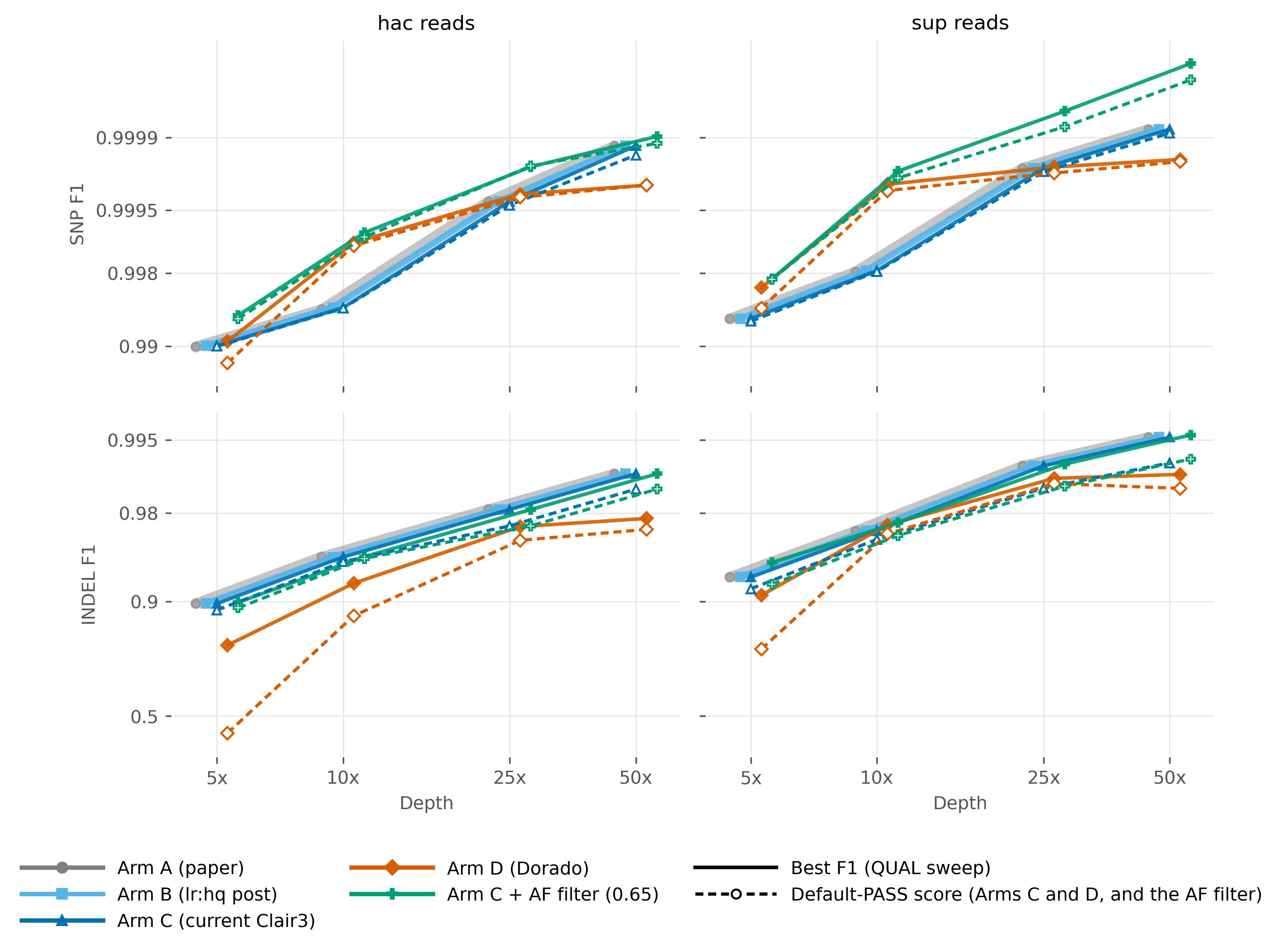
Figure 1: Median F1 over the 14 samples against depth, for SNPs (top) and indels (bottom) with hac (left) and sup (right) reads. Solid lines are Best F1; dashed lines with open markers are the Default-PASS score, for Arms C and D and the AF filter. F1 is on a logit scale, which spreads out the differences close to 1. Points are ‘jittered’ (horizontally) so they don’t hide each other; each belongs to the depth below it. AF is allele frequency, the fraction of reads carrying an allele. Arm C + AF filter (0.65) is Clair3 run diploid, with each heterozygous call made the alternative allele when its AF is ≥ 0.65 and the reference otherwise.
Clair3 with the AF filter has the highest median SNP F1 at every depth, for both read models (Figure 1, top row):
| Reads | Depth | Clair3 (C) | Clair3 + AF filter | Dorado (D) |
|---|---|---|---|---|
| hac | 5x | 0.99003 | 0.99489 | 0.99098 |
| hac | 10x | 0.99569 | 0.99918 | 0.99897 |
| hac | 25x | 0.99959 | 0.99981 | 0.99965 |
| hac | 50x | 0.99988 | 0.99990 | 0.99971 |
| sup | 5x | 0.99451 | 0.99771 | 0.99722 |
| sup | 10x | 0.99810 | 0.99979 | 0.99972 |
| sup | 25x | 0.99980 | 0.99994 | 0.99981 |
| sup | 50x | 0.99992 | 0.99998 | 0.99984 |
Median SNP Best F1.
These numbers are all close to 1, so error counts show the differences more clearly. At sup 50x, Clair3 with the AF filter made 23 SNP errors over the 14 genomes, Clair3 with the paper’s settings 48, and Dorado 83. That is fewer than two errors per genome against about six. Clair3 with the filter got a perfect SNP score on 6 of the 14 samples; Dorado did on 2. At sup 25x the counts are 35, 218 and 89. With hac reads at 50x the gap is smaller (48, 98 and 122). Dorado’s extra errors at 50x are mostly missed SNPs (71 vs 20 for sup, 103 vs 47 for hac), plus a few more false positives (12 vs 3, and 19 vs 1).
Against Clair3 with the paper’s settings, Dorado is better at 5x and 10x. The two are level at 25x, and Clair3 is slightly ahead at 50x. At low depth the difference is mostly SNPs that Clair3 misses. For example, at hac 10x Clair3 misses 2,478 of the 203,164 truth SNPs (1.2%) and Dorado misses 320. Two-thirds of Clair3’s misses come from three of the samples, though Clair3 misses more than Dorado on 13 of the 144. By 50x the gap is gone: Clair3 misses 97 and Dorado 103.
Why Clair3 misses SNPs#
The missing SNPs are mostly het calls that --haploid_precise throws away. In bacteria, a het
call often points to a mixed sample, or to variants that arose while the isolate was cultured.
Though repeats can also cause them. Reads from another copy of the repeat pile up at
the same position, so the variant looks as if it is on only some of the reads (Figure 2). On one
E. coli sample at hac 50x, 46 of Clair3’s 50 missed SNPs were dropped this way. At low depth
many more true SNPs are called het: at hac 10x, the het calls the AF filter rescues have a
median AF of 0.8 to 0.9 in each sample.
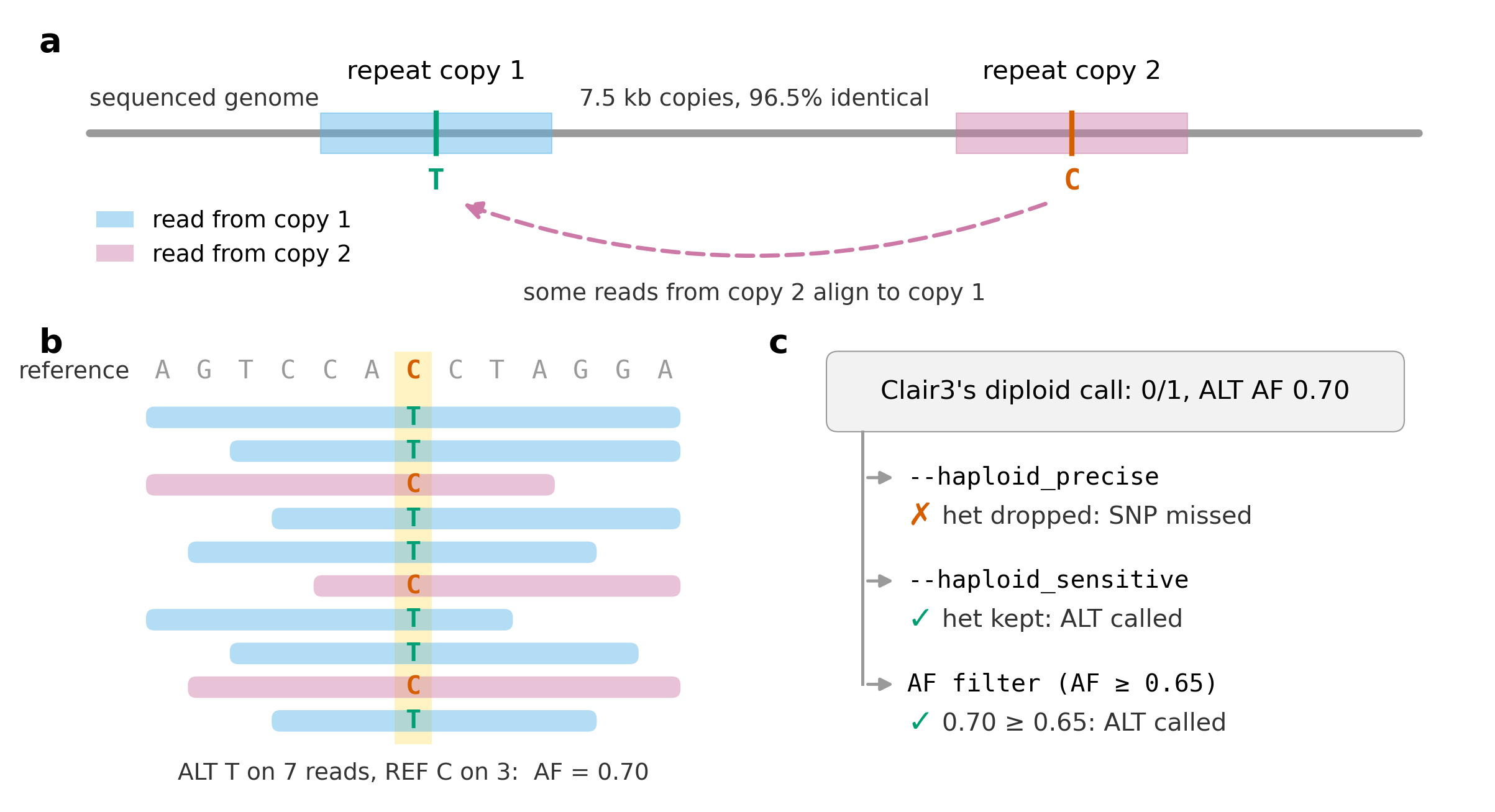
Figure 2: How a repeat turns a true SNP into a het call. a, The sequenced genome has two similar copies of a repeat, like the two 7.5 kb copies, 96.5% identical, in our E. coli sample. The SNP (T) is in copy 1 only. b, Some reads from copy 2 align to copy 1 with full mapping quality (MAPQ 60), carrying the reference base (C), so only some of the reads at the SNP carry the ALT. The read counts are illustrative: at the SNPs Clair3 missed in this sample, 60–85% of reads carried the ALT. c, Clair3’s diploid model calls the site heterozygous. --haploid_precise drops the call, and --haploid_sensitive and the AF filter both call the ALT. A mixed sample, with reads from another strain in place of the reads from copy 2, gives the same kind of pileup.
--haploid_sensitive keeps those calls, but it also keeps minority alleles at around 20% AF,
and QUAL can’t tell those apart from the real variants. With the filter, Clair3’s
misses at hac 10x fall from 2,478 to 304, for 78 more false positives. Its indels are no worse
at any depth, and a little better at low depth (sup 5x: 0.935 to 0.950).
The 0.65 threshold works across samples, depths and read models. Compared with each sample’s own best threshold, the typical sample loses nothing at 0.65. The worst one loses 0.001 SNP F1 and 0.017 indel F1. 0.70 and 0.75 are almost as good.
Indels: Clair3 is better#
Clair3 is ahead on indels at almost every depth: at 50x, 0.990 against 0.978 for hac and 0.995 against 0.990 for sup. The gap is largest at low depth (hac 5x: 0.896 vs 0.796). The one place Dorado is ahead is sup at 10x, and only just (0.975 vs 0.972). The AF filter makes almost no difference to Clair3’s indels at 25x and 50x.
Dorado’s default filter is too lenient at low depth#
The dashed lines in Figure 1 show what you get without tuning a threshold. Clair3’s PASS
filter costs it very little. At 50x Dorado’s costs little too (sup SNP F1 0.9998 either way),
but at low depth it costs a lot: at hac 5x its indel F1 falls from 0.796 (Best F1) to 0.419
(Default-PASS).
Dorado’s filter lets too much through. At hac 5x its PASS calls include 9,540 false
positive indels across the samples, against 503 at the best threshold. Dorado marks fewer than
4% of its records LowQual.
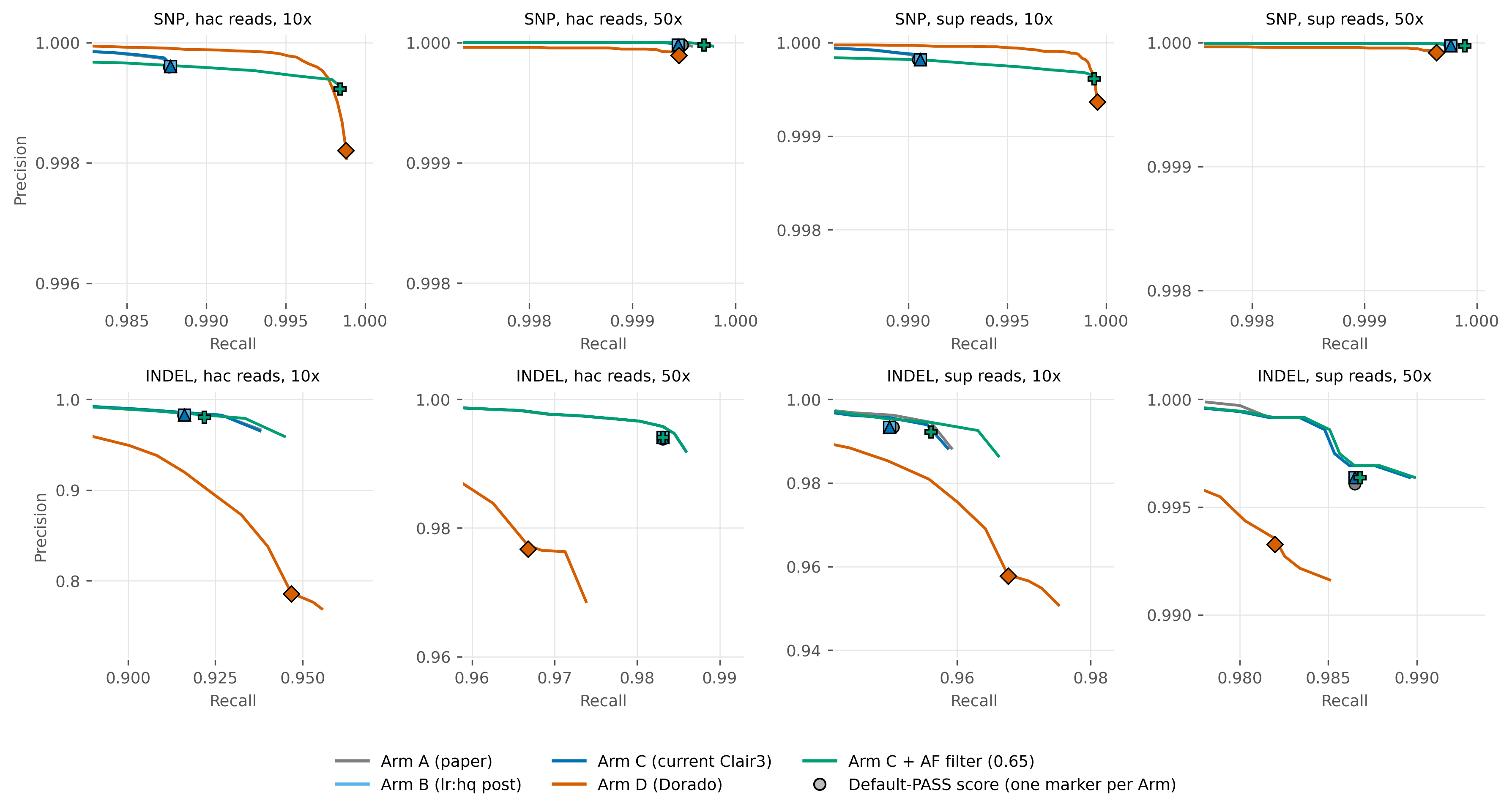
Figure 3: Precision-recall curves over QUAL thresholds at 10x and 50x, for SNPs (top) and indels (bottom). Each curve pools all 14 samples, summing their true and false calls at each threshold. Markers show each arm’s Default-PASS score, pooled the same way. Each panel is zoomed to its own range. Arm C + AF filter (0.65) is as in Figure 1.
So for Ryan’s suggestion, Dorado’s QUAL does separate bad calls from good ones, at least at low depth (Figure 3). The best threshold depends on depth, though: QUAL ≥ 10 fixes most of the low-depth problem but costs a little at 50x5.
Per sample#
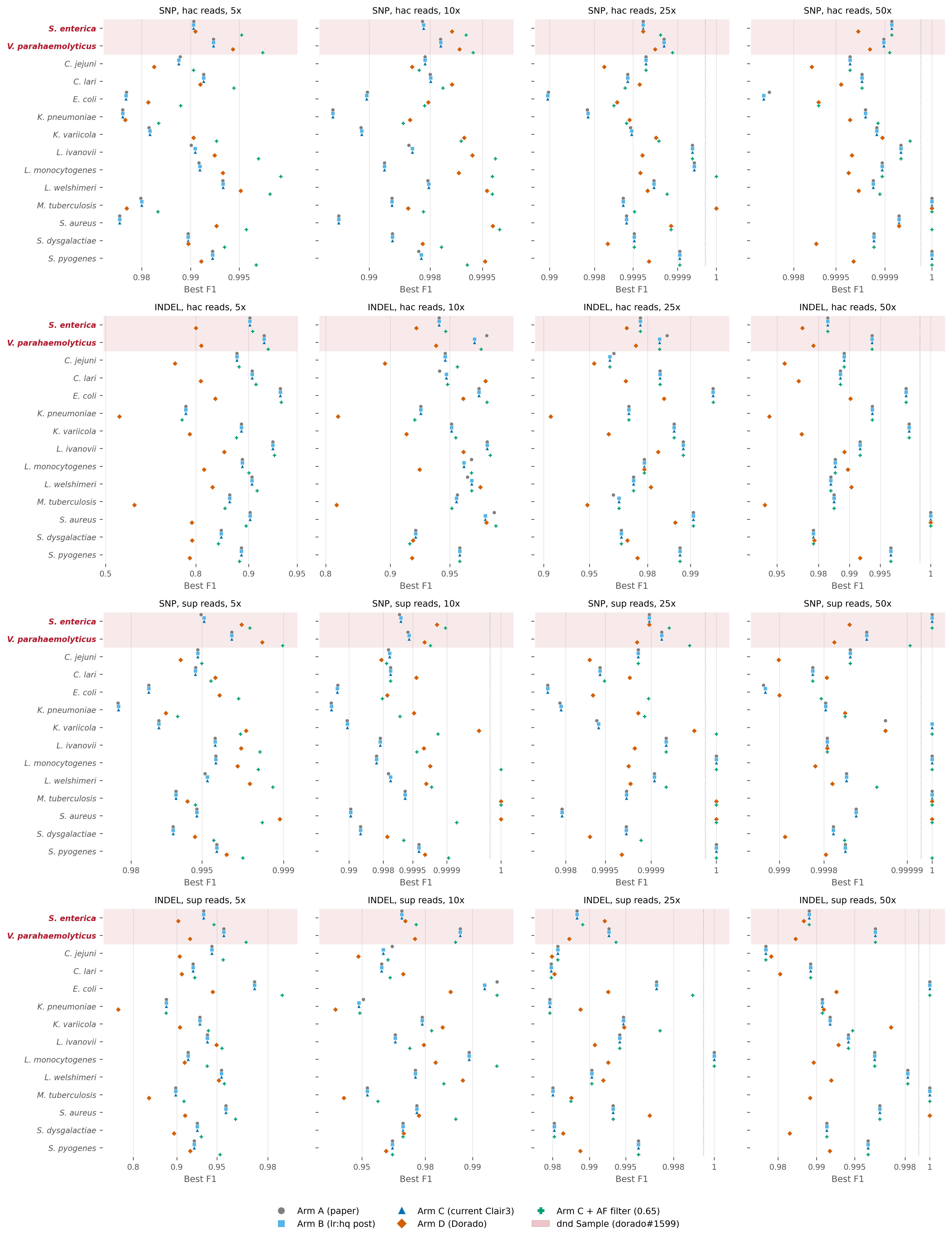
Figure 4: Best F1 for every sample at every depth, for SNPs and indels with hac and sup reads. F1 is on a logit scale and each panel has its own axis. A perfect score (F1 = 1) has no place on a logit scale, so perfect scores are drawn in their own column after the dotted line. The two shaded samples, S. enterica and V. parahaemolyticus, carry dnd phosphorothioate systems (dorado#1599). Arm C + AF filter (0.65) is as in Figure 1.
The pattern holds across samples (Figure 4). At sup 50x, Clair3 with the AF filter beats Dorado on SNPs for 9 of the 14 samples and ties on 4. Clair3 beats Dorado on indels for 10 of the 14 at 50x with either read model. Dorado’s weakest indel results are K. pneumoniae and M. tuberculosis.
There is a known issue where Dorado’s bacterial model makes systematic errors in genomes with dnd phosphorothioate modifications, such as Salmonella enterica. Our S. enterica and V. parahaemolyticus samples have dnd systems, but they don’t stand out here. That issue was reported for reads basecalled with hac v6.0, and our reads are v4.3.0.
Newer Clair3 and lr:hq change little#
Arms A, B and C are almost indistinguishable in Figure 1. Moving from map-ont to lr:hq
changed median Best F1 by at most 0.0003. Moving from Clair3 1.0.5 to 2.0.3 with the same
(converted) models gave identical Best F1 for every sample, depth and read model. Clair3 2.0.3
is faster, though.
Runtime and memory#
Median per 50x read set, over 28 read sets (14 samples, hac and sup), on 8 threads of an AMD EPYC 9745 or one NVIDIA H100:
| Step | Tool | Device | Wall time | Peak RAM |
|---|---|---|---|---|
| Alignment | minimap2 2.31 lr:hq | CPU | 12 s | 0.9 GB |
| Variant calling | Clair3 1.0.5 | CPU | 61 s | 1.2 GB |
| Variant calling | Clair3 2.0.3 | CPU | 49 s | 1.0 GB |
| Variant calling | dorado polish | GPU | 4.6 s | 1.4 GB |
| Variant calling | dorado polish | CPU | 59 s | 9.7 GB |
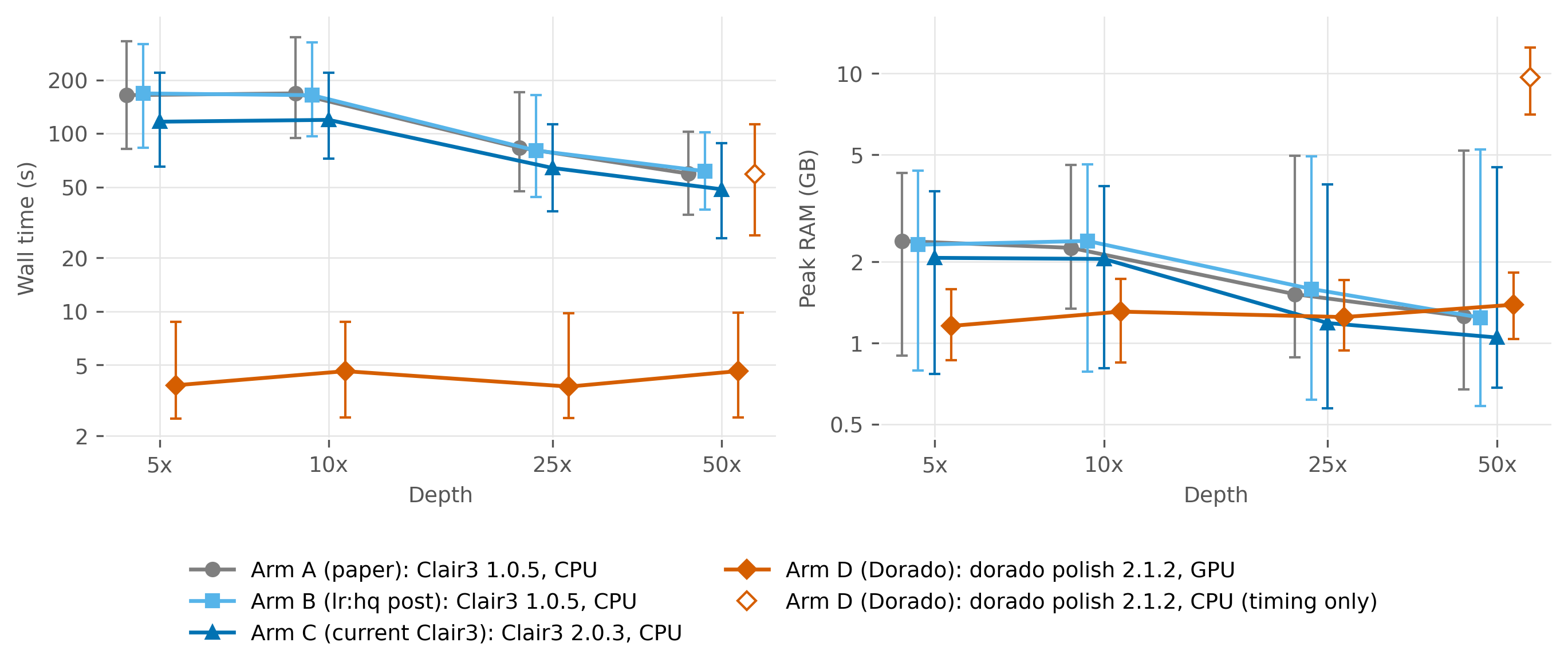
Figure 5: Wall time (left) and peak RAM (right) of variant calling against depth, both on log scales. Points are medians over the 28 read sets (14 samples, hac and sup) and bars show the range. Clair3 (Arms A-C) ran on 8 threads of an AMD EPYC 9745, and dorado polish (Arm D) on one NVIDIA H100 with 8 threads. The open marker is Dorado run on 8 CPU threads at 50x, for timing only. Alignment isn’t shown. Peak RAM is host memory: Dorado’s GPU memory isn’t measured.
On a GPU, Dorado is at least ten times faster than Clair3 at every depth (Figure 5). On CPU it takes about as long, but needs much more memory. However, waiting in the queue on my HPC for a GPU took longer than the difference in time to CPU, so realistically, I would just use CPU unless you have instant access to an H100 and are extremely impatient (or need to call thousands of samples). Clair3 took longer at 5x and 10x (two to three minutes) than at 50x, and used more memory too. I haven’t looked into why. The full breakdown, including alignment, is in Table 1.
Caveats#
- Only v4.3.0 reads. These are the reads from the paper. Newer basecalling models give more accurate reads, and both callers may do better on them.
- Clair3’s bacterial model wasn’t tested. Clair3 now ships a model fine-tuned on bacteria
(
r1041_e82_400bps_sup_v430_bacteria_finetuned). It was trained on 12 of our 14 samples, so testing it here would mean scoring it on its own training data. dorado smallvarwasn’t tested properly. Dorado’s new small variant caller only has models for hac v5.2.0 and v6.0.0 reads. I tried forcing the v6.0.0 model onto our v4.3.0 reads on three samples. It was worse than both other callers on SNPs, but competitive on indels. A fair test needs rebasecalled reads.- Newer polishing models and duplex reads weren’t tested, for the same reason.
- The AF filter threshold was chosen on the same data.
- Depth capping gives more even coverage than you would see in practice, so real low-depth data may do worse than shown here, for every caller.
Conclusion#
If you are calling variants in bacterial genomes from ONT reads:
- Clair3 is still the best overall, especially for indels.
dorado polish --vcfis a reasonable choice for SNPs, particularly if you have a GPU and want speed. At 50x it makes a few more SNP errors per genome than Clair3. Its indels lag behind Clair3’s.
If you use
--haploid_precise, consider running Clair3 diploid with an AF filter instead. It recovers the SNPs that--haploid_precisethrows away, and costs nothing on indels. It gave the best SNP results in this benchmark at every depth.
Don’t trust Dorado’s
PASSfilter at low depth: filter on QUAL (around 10 at 5–10x).
Acknowledgements#
Thanks to Ryan Wick, who got the ball rolling on this.
Appendix#
The workflow, the aggregated tables and the figures are in the NanoVarBench repository. The filtered VCFs for every arm and read set, and vcfdist’s outputs for each, are on Zenodo: doi:10.5281/zenodo.23180742.
Table S1: Per-sample results for every arm, depth and read model, with actual depths
Preview source code
Sample,Species,dnd Sample,Read model,Depth (x),Actual depth (x),Actual depth by contig (x),Arm,SNP Best precision,SNP Best recall,SNP Best F1,SNP Best QUAL threshold,SNP Default-PASS precision,SNP Default-PASS recall,SNP Default-PASS F1,INDEL Best precision,INDEL Best recall,INDEL Best F1,INDEL Best QUAL threshold,INDEL Default-PASS precision,INDEL Default-PASS recall,INDEL Default-PASS F1
AJ292__202310,Klebsiella variicola,false,hac,5,4.97,chromosome 4.97,A (paper),0.998868,0.965645,0.981976,0,0.998868,0.965383,0.981840,0.903743,0.875648,0.889474,1,0.920904,0.844560,0.881081
AJ292__202310,Klebsiella variicola,false,hac,5,4.97,chromosome 4.97,B (lr:hq post),0.998869,0.966083,0.982202,0,0.998868,0.965821,0.982067,0.903743,0.875648,0.889474,1,0.920904,0.844560,0.881081
AJ292__202310,Klebsiella variicola,false,hac,5,4.97,chromosome 4.97,C (current Clair3),0.998869,0.966083,0.982202,0,0.998868,0.965821,0.982067,0.903743,0.875648,0.889474,1,0.920904,0.844560,0.881081
AJ292__202310,Klebsiella variicola,false,hac,5,4.97,chromosome 4.97,D (Dorado),0.992832,0.988009,0.990414,9,0.975974,0.995536,0.985658,0.840237,0.735751,0.784530,16,0.172211,0.911917,0.289712
AJ292__202310,Klebsiella variicola,false,hac,5,4.97,chromosome 4.97,C + AF filter (0.65),0.997791,0.988403,0.993075,0,0.997791,0.988184,0.992964,0.873096,0.891192,0.882051,1,0.891304,0.849741,0.870027
AJ292__202310,Klebsiella variicola,false,hac,10,9.90,chromosome 9.90,A (paper),0.999865,0.975755,0.987663,0,0.999821,0.975667,0.987596,0.948454,0.953368,0.950904,0,0.957672,0.937824,0.947644
AJ292__202310,Klebsiella variicola,false,hac,10,9.90,chromosome 9.90,B (lr:hq post),0.999866,0.976105,0.987842,0,0.999821,0.976018,0.987776,0.948454,0.953368,0.950904,0,0.957672,0.937824,0.947644
AJ292__202310,Klebsiella variicola,false,hac,10,9.90,chromosome 9.90,C (current Clair3),0.999866,0.976105,0.987842,0,0.999821,0.976018,0.987776,0.948454,0.953368,0.950904,0,0.957672,0.937824,0.947644
AJ292__202310,Klebsiella variicola,false,hac,10,9.90,chromosome 9.90,D (Dorado),0.999256,0.999125,0.999190,3,0.999256,0.999125,0.999190,0.921466,0.911917,0.916667,10,0.666667,0.953368,0.784648
AJ292__202310,Klebsiella variicola,false,hac,10,9.90,chromosome 9.90,C + AF filter (0.65),0.999781,0.998468,0.999124,0,0.999737,0.998381,0.999058,0.953368,0.953368,0.953368,1,0.958115,0.948187,0.953125
AJ292__202310,Klebsiella variicola,false,hac,25,24.71,chromosome 24.71,A (paper),1.000000,0.998906,0.999453,0,1.000000,0.998950,0.999475,0.994737,0.979275,0.986945,2,0.994737,0.979275,0.986945
AJ292__202310,Klebsiella variicola,false,hac,25,24.71,chromosome 24.71,B (lr:hq post),1.000000,0.998950,0.999475,0,1.000000,0.998993,0.999497,0.994737,0.979275,0.986945,2,0.994737,0.979275,0.986945
AJ292__202310,Klebsiella variicola,false,hac,25,24.71,chromosome 24.71,C (current Clair3),1.000000,0.998950,0.999475,0,1.000000,0.998993,0.999497,0.994737,0.979275,0.986945,2,0.994737,0.979275,0.986945
AJ292__202310,Klebsiella variicola,false,hac,25,24.71,chromosome 24.71,D (Dorado),0.999825,0.999737,0.999781,0,0.999825,0.999650,0.999737,0.983784,0.943005,0.962963,9,0.925743,0.968912,0.946835
AJ292__202310,Klebsiella variicola,false,hac,25,24.71,chromosome 24.71,C + AF filter (0.65),1.000000,0.999606,0.999803,0,1.000000,0.999650,0.999825,0.994737,0.979275,0.986945,2,0.994737,0.979275,0.986945
AJ292__202310,Klebsiella variicola,false,hac,50,49.02,chromosome 49.02,A (paper),1.000000,0.999737,0.999869,0,1.000000,0.999650,0.999825,1.000000,0.994819,0.997403,0,1.000000,0.994819,0.997403
AJ292__202310,Klebsiella variicola,false,hac,50,49.02,chromosome 49.02,B (lr:hq post),1.000000,0.999737,0.999869,0,1.000000,0.999650,0.999825,1.000000,0.994819,0.997403,0,1.000000,0.994819,0.997403
AJ292__202310,Klebsiella variicola,false,hac,50,49.02,chromosome 49.02,C (current Clair3),1.000000,0.999737,0.999869,0,1.000000,0.999650,0.999825,1.000000,0.994819,0.997403,0,1.000000,0.994819,0.997403
AJ292__202310,Klebsiella variicola,false,hac,50,49.02,chromosome 49.02,D (Dorado),1.000000,0.999781,0.999891,0,0.999956,0.999737,0.999847,0.994565,0.948187,0.970822,7,0.944444,0.968912,0.956522
AJ292__202310,Klebsiella variicola,false,hac,50,49.02,chromosome 49.02,C + AF filter (0.65),1.000000,0.999913,0.999956,0,1.000000,0.999825,0.999912,1.000000,0.994819,0.997403,0,1.000000,0.994819,0.997403
AJ292__202310,Klebsiella variicola,false,sup,5,4.99,chromosome 4.99,A (paper),0.999731,0.977155,0.988314,0,0.999776,0.977068,0.988292,0.971910,0.896373,0.932615,0,0.988095,0.860104,0.919668
AJ292__202310,Klebsiella variicola,false,sup,5,4.99,chromosome 4.99,B (lr:hq post),0.999731,0.977199,0.988337,0,0.999776,0.977112,0.988314,0.971910,0.896373,0.932615,0,0.988095,0.860104,0.919668
AJ292__202310,Klebsiella variicola,false,sup,5,4.99,chromosome 4.99,C (current Clair3),0.999731,0.977199,0.988337,0,0.999776,0.977112,0.988314,0.971910,0.896373,0.932615,0,0.988095,0.860104,0.919668
AJ292__202310,Klebsiella variicola,false,sup,5,4.99,chromosome 4.99,D (Dorado),0.998292,0.997505,0.997898,8,0.994338,0.999081,0.996704,0.948864,0.865285,0.905149,12,0.550898,0.953368,0.698292
AJ292__202310,Klebsiella variicola,false,sup,5,4.99,chromosome 4.99,C + AF filter (0.65),0.999736,0.995580,0.997654,0,0.999780,0.995492,0.997632,0.962162,0.922280,0.941799,0,0.982558,0.875648,0.926027
AJ292__202310,Klebsiella variicola,false,sup,10,9.97,chromosome 9.97,A (paper),1.000000,0.978424,0.989095,0,1.000000,0.978424,0.989095,0.989418,0.968912,0.979058,0,0.989247,0.953368,0.970976
AJ292__202310,Klebsiella variicola,false,sup,10,9.97,chromosome 9.97,B (lr:hq post),1.000000,0.978600,0.989184,0,1.000000,0.978600,0.989184,0.989418,0.968912,0.979058,0,0.989247,0.953368,0.970976
AJ292__202310,Klebsiella variicola,false,sup,10,9.97,chromosome 9.97,C (current Clair3),1.000000,0.978600,0.989184,0,1.000000,0.978600,0.989184,0.989418,0.968912,0.979058,0,0.989247,0.953368,0.970976
AJ292__202310,Klebsiella variicola,false,sup,10,9.97,chromosome 9.97,D (Dorado),1.000000,0.999956,0.999978,4,0.999956,0.999956,0.999956,0.984456,0.984456,0.984456,7,0.959596,0.984456,0.971867
AJ292__202310,Klebsiella variicola,false,sup,10,9.97,chromosome 9.97,C + AF filter (0.65),1.000000,0.999694,0.999847,0,1.000000,0.999694,0.999847,0.989474,0.974093,0.981723,0,0.989305,0.958549,0.973684
AJ292__202310,Klebsiella variicola,false,sup,25,24.90,chromosome 24.90,A (paper),1.000000,0.998643,0.999321,0,1.000000,0.998643,0.999321,1.000000,0.989637,0.994792,0,1.000000,0.989637,0.994792
AJ292__202310,Klebsiella variicola,false,sup,25,24.90,chromosome 24.90,B (lr:hq post),1.000000,0.998731,0.999365,0,1.000000,0.998731,0.999365,1.000000,0.989637,0.994792,0,1.000000,0.989637,0.994792
AJ292__202310,Klebsiella variicola,false,sup,25,24.90,chromosome 24.90,C (current Clair3),1.000000,0.998731,0.999365,0,1.000000,0.998731,0.999365,1.000000,0.989637,0.994792,0,1.000000,0.989637,0.994792
AJ292__202310,Klebsiella variicola,false,sup,25,24.90,chromosome 24.90,D (Dorado),1.000000,0.999956,0.999978,0,1.000000,0.999956,0.999978,0.989744,1.000000,0.994845,0,0.989744,1.000000,0.994845
AJ292__202310,Klebsiella variicola,false,sup,25,24.90,chromosome 24.90,C + AF filter (0.65),1.000000,1.000000,1.000000,0,1.000000,1.000000,1.000000,1.000000,0.994819,0.997403,0,1.000000,0.994819,0.997403
AJ292__202310,Klebsiella variicola,false,sup,50,49.45,chromosome 49.45,A (paper),1.000000,0.999956,0.999978,0,1.000000,0.999956,0.999978,1.000000,0.984456,0.992167,0,1.000000,0.984456,0.992167
AJ292__202310,Klebsiella variicola,false,sup,50,49.45,chromosome 49.45,B (lr:hq post),1.000000,1.000000,1.000000,0,1.000000,1.000000,1.000000,1.000000,0.984456,0.992167,0,1.000000,0.984456,0.992167
AJ292__202310,Klebsiella variicola,false,sup,50,49.45,chromosome 49.45,C (current Clair3),1.000000,1.000000,1.000000,0,1.000000,1.000000,1.000000,1.000000,0.984456,0.992167,0,1.000000,0.984456,0.992167
AJ292__202310,Klebsiella variicola,false,sup,50,49.45,chromosome 49.45,D (Dorado),1.000000,0.999956,0.999978,0,1.000000,0.999956,0.999978,0.994845,1.000000,0.997416,0,0.994845,1.000000,0.997416
AJ292__202310,Klebsiella variicola,false,sup,50,49.45,chromosome 49.45,C + AF filter (0.65),1.000000,1.000000,1.000000,0,1.000000,1.000000,1.000000,1.000000,0.989637,0.994792,0,1.000000,0.989637,0.994792
AMtb_1__202402,Mycobacterium tuberculosis,false,hac,5,4.99,chromosome 4.99,A (paper),0.991715,0.968126,0.979778,4,0.988349,0.968601,0.978376,0.919255,0.826816,0.870588,1,0.929936,0.815642,0.869048
AMtb_1__202402,Mycobacterium tuberculosis,false,hac,5,4.99,chromosome 4.99,B (lr:hq post),0.991719,0.968601,0.980024,4,0.988355,0.969077,0.978621,0.919255,0.826816,0.870588,1,0.929936,0.815642,0.869048
AMtb_1__202402,Mycobacterium tuberculosis,false,hac,5,4.99,chromosome 4.99,C (current Clair3),0.991719,0.968601,0.980024,4,0.988355,0.969077,0.978621,0.919255,0.826816,0.870588,1,0.929936,0.815642,0.869048
AMtb_1__202402,Mycobacterium tuberculosis,false,hac,5,4.99,chromosome 4.99,D (Dorado),0.981223,0.969553,0.975353,17,0.784991,0.995243,0.877701,0.653846,0.569832,0.608955,15,0.134068,0.815642,0.230284
AMtb_1__202402,Mycobacterium tuberculosis,false,hac,5,4.99,chromosome 4.99,C + AF filter (0.65),0.982456,0.985728,0.984089,4,0.979216,0.986204,0.982697,0.887574,0.837989,0.862069,1,0.901841,0.821229,0.859649
AMtb_1__202402,Mycobacterium tuberculosis,false,hac,10,9.98,chromosome 9.98,A (paper),0.999040,0.990009,0.994504,0,0.999040,0.990009,0.994504,0.976608,0.932961,0.954286,0,0.993902,0.910615,0.950437
AMtb_1__202402,Mycobacterium tuberculosis,false,hac,10,9.98,chromosome 9.98,B (lr:hq post),0.999040,0.990009,0.994504,0,0.999040,0.990009,0.994504,0.988024,0.921788,0.953757,1,0.993939,0.916201,0.953488
AMtb_1__202402,Mycobacterium tuberculosis,false,hac,10,9.98,chromosome 9.98,C (current Clair3),0.999040,0.990009,0.994504,0,0.999040,0.990009,0.994504,0.988024,0.921788,0.953757,1,0.993939,0.916201,0.953488
AMtb_1__202402,Mycobacterium tuberculosis,false,hac,10,9.98,chromosome 9.98,D (Dorado),0.998567,0.994291,0.996424,9,0.991021,0.997621,0.994310,0.900000,0.754190,0.820669,8,0.668142,0.843575,0.745679
AMtb_1__202402,Mycobacterium tuberculosis,false,hac,10,9.98,chromosome 9.98,C + AF filter (0.65),0.998570,0.996670,0.997619,0,0.998570,0.996670,0.997619,0.982143,0.921788,0.951009,1,0.993939,0.916201,0.953488
AMtb_1__202402,Mycobacterium tuberculosis,false,hac,25,24.92,chromosome 24.92,A (paper),1.000000,0.998573,0.999286,0,1.000000,0.998573,0.999286,0.994083,0.938547,0.965517,0,1.000000,0.932961,0.965318
AMtb_1__202402,Mycobacterium tuberculosis,false,hac,25,24.92,chromosome 24.92,B (lr:hq post),1.000000,0.998573,0.999286,0,1.000000,0.998573,0.999286,0.994118,0.944134,0.968481,0,1.000000,0.938547,0.968300
AMtb_1__202402,Mycobacterium tuberculosis,false,hac,25,24.92,chromosome 24.92,C (current Clair3),1.000000,0.998573,0.999286,0,1.000000,0.998573,0.999286,0.994118,0.944134,0.968481,0,1.000000,0.938547,0.968300
AMtb_1__202402,Mycobacterium tuberculosis,false,hac,25,24.92,chromosome 24.92,D (Dorado),1.000000,1.000000,1.000000,0,1.000000,1.000000,1.000000,0.976331,0.921788,0.948276,1,0.963855,0.893855,0.927536
AMtb_1__202402,Mycobacterium tuberculosis,false,hac,25,24.92,chromosome 24.92,C + AF filter (0.65),1.000000,0.999049,0.999524,0,1.000000,0.999049,0.999524,0.994118,0.944134,0.968481,0,1.000000,0.938547,0.968300
AMtb_1__202402,Mycobacterium tuberculosis,false,hac,50,49.73,chromosome 49.73,A (paper),1.000000,1.000000,1.000000,0,1.000000,1.000000,1.000000,1.000000,0.972067,0.985836,0,1.000000,0.960894,0.980057
AMtb_1__202402,Mycobacterium tuberculosis,false,hac,50,49.73,chromosome 49.73,B (lr:hq post),1.000000,1.000000,1.000000,0,1.000000,1.000000,1.000000,1.000000,0.972067,0.985836,0,1.000000,0.966480,0.982955
AMtb_1__202402,Mycobacterium tuberculosis,false,hac,50,49.73,chromosome 49.73,C (current Clair3),1.000000,1.000000,1.000000,0,1.000000,1.000000,1.000000,1.000000,0.972067,0.985836,0,1.000000,0.966480,0.982955
AMtb_1__202402,Mycobacterium tuberculosis,false,hac,50,49.73,chromosome 49.73,D (Dorado),1.000000,1.000000,1.000000,3,1.000000,1.000000,1.000000,0.987578,0.888268,0.935294,1,0.987500,0.882682,0.932153
AMtb_1__202402,Mycobacterium tuberculosis,false,hac,50,49.73,chromosome 49.73,C + AF filter (0.65),1.000000,1.000000,1.000000,0,1.000000,1.000000,1.000000,1.000000,0.972067,0.985836,0,1.000000,0.966480,0.982955
AMtb_1__202402,Mycobacterium tuberculosis,false,sup,5,5.03,chromosome 5.03,A (paper),0.996636,0.986679,0.991633,4,0.994724,0.986679,0.990685,0.967742,0.837989,0.898204,1,0.979866,0.815642,0.890244
AMtb_1__202402,Mycobacterium tuberculosis,false,sup,5,5.03,chromosome 5.03,B (lr:hq post),0.996636,0.986679,0.991633,4,0.994724,0.986679,0.990685,0.967742,0.837989,0.898204,1,0.979866,0.815642,0.890244
AMtb_1__202402,Mycobacterium tuberculosis,false,sup,5,5.03,chromosome 5.03,C (current Clair3),0.996636,0.986679,0.991633,4,0.994724,0.986679,0.990685,0.967742,0.837989,0.898204,1,0.979866,0.815642,0.890244
AMtb_1__202402,Mycobacterium tuberculosis,false,sup,5,5.03,chromosome 5.03,D (Dorado),0.995698,0.990961,0.993324,17,0.928445,1.000000,0.962895,0.920530,0.776536,0.842424,11,0.455882,0.865922,0.597302
AMtb_1__202402,Mycobacterium tuberculosis,false,sup,5,5.03,chromosome 5.03,C + AF filter (0.65),0.993352,0.995243,0.994297,4,0.991469,0.995243,0.993352,0.968553,0.860335,0.911243,1,0.980392,0.837989,0.903614
AMtb_1__202402,Mycobacterium tuberculosis,false,sup,10,10.05,chromosome 10.05,A (paper),1.000000,0.998573,0.999286,0,1.000000,0.998573,0.999286,0.988024,0.921788,0.953757,1,0.993902,0.910615,0.950437
AMtb_1__202402,Mycobacterium tuberculosis,false,sup,10,10.05,chromosome 10.05,B (lr:hq post),1.000000,0.998573,0.999286,0,1.000000,0.998573,0.999286,0.988024,0.921788,0.953757,1,0.993902,0.910615,0.950437
AMtb_1__202402,Mycobacterium tuberculosis,false,sup,10,10.05,chromosome 10.05,C (current Clair3),1.000000,0.998573,0.999286,0,1.000000,0.998573,0.999286,0.988024,0.921788,0.953757,1,0.993902,0.910615,0.950437
AMtb_1__202402,Mycobacterium tuberculosis,false,sup,10,10.05,chromosome 10.05,D (Dorado),1.000000,1.000000,1.000000,6,0.999524,1.000000,0.999762,0.938202,0.932961,0.935574,1,0.936416,0.905028,0.920455
AMtb_1__202402,Mycobacterium tuberculosis,false,sup,10,10.05,chromosome 10.05,C + AF filter (0.65),1.000000,1.000000,1.000000,0,1.000000,1.000000,1.000000,0.976879,0.944134,0.960227,1,0.988166,0.932961,0.959770
AMtb_1__202402,Mycobacterium tuberculosis,false,sup,25,25.07,chromosome 25.07,A (paper),1.000000,0.999524,0.999762,0,1.000000,0.999524,0.999762,1.000000,0.960894,0.980057,0,1.000000,0.955307,0.977143
AMtb_1__202402,Mycobacterium tuberculosis,false,sup,25,25.07,chromosome 25.07,B (lr:hq post),1.000000,0.999524,0.999762,0,1.000000,0.999524,0.999762,1.000000,0.960894,0.980057,0,1.000000,0.955307,0.977143
AMtb_1__202402,Mycobacterium tuberculosis,false,sup,25,25.07,chromosome 25.07,C (current Clair3),1.000000,0.999524,0.999762,0,1.000000,0.999524,0.999762,1.000000,0.960894,0.980057,0,1.000000,0.955307,0.977143
AMtb_1__202402,Mycobacterium tuberculosis,false,sup,25,25.07,chromosome 25.07,D (Dorado),1.000000,1.000000,1.000000,1,1.000000,1.000000,1.000000,0.994318,0.977654,0.985915,0,1.000000,0.949721,0.974212
AMtb_1__202402,Mycobacterium tuberculosis,false,sup,25,25.07,chromosome 25.07,C + AF filter (0.65),1.000000,1.000000,1.000000,0,1.000000,1.000000,1.000000,1.000000,0.972067,0.985836,0,1.000000,0.966480,0.982955
AMtb_1__202402,Mycobacterium tuberculosis,false,sup,50,50.06,chromosome 50.06,A (paper),1.000000,1.000000,1.000000,0,1.000000,1.000000,1.000000,1.000000,1.000000,1.000000,0,1.000000,0.983240,0.991549
AMtb_1__202402,Mycobacterium tuberculosis,false,sup,50,50.06,chromosome 50.06,B (lr:hq post),1.000000,1.000000,1.000000,0,1.000000,1.000000,1.000000,1.000000,1.000000,1.000000,0,1.000000,0.983240,0.991549
AMtb_1__202402,Mycobacterium tuberculosis,false,sup,50,50.06,chromosome 50.06,C (current Clair3),1.000000,1.000000,1.000000,0,1.000000,1.000000,1.000000,1.000000,1.000000,1.000000,0,1.000000,0.983240,0.991549
AMtb_1__202402,Mycobacterium tuberculosis,false,sup,50,50.06,chromosome 50.06,D (Dorado),1.000000,1.000000,1.000000,0,1.000000,1.000000,1.000000,0.994350,0.983240,0.988764,0,1.000000,0.955307,0.977143
AMtb_1__202402,Mycobacterium tuberculosis,false,sup,50,50.06,chromosome 50.06,C + AF filter (0.65),1.000000,1.000000,1.000000,0,1.000000,1.000000,1.000000,1.000000,1.000000,1.000000,0,1.000000,0.983240,0.991549
ATCC_10708__202309,Salmonella enterica,true,hac,5,5.03,chromosome 5.03; plasmid 5.13,A (paper),0.998970,0.982059,0.990443,1,0.998916,0.981899,0.990335,0.963585,0.847118,0.901606,1,0.965812,0.839599,0.898294
ATCC_10708__202309,Salmonella enterica,true,hac,5,5.03,chromosome 5.03; plasmid 5.13,B (lr:hq post),0.998970,0.982006,0.990415,1,0.998916,0.981846,0.990308,0.963585,0.847118,0.901606,1,0.965812,0.839599,0.898294
ATCC_10708__202309,Salmonella enterica,true,hac,5,5.03,chromosome 5.03; plasmid 5.13,C (current Clair3),0.998970,0.982006,0.990415,1,0.998916,0.981846,0.990308,0.963585,0.847118,0.901606,1,0.965812,0.839599,0.898294
ATCC_10708__202309,Salmonella enterica,true,hac,5,5.03,chromosome 5.03; plasmid 5.13,D (Dorado),0.991883,0.989459,0.990669,9,0.974771,0.996273,0.985405,0.901538,0.719298,0.800173,14,0.342830,0.887218,0.494558
ATCC_10708__202309,Salmonella enterica,true,hac,5,5.03,chromosome 5.03; plasmid 5.13,C + AF filter (0.65),0.997911,0.992440,0.995168,1,0.997804,0.992334,0.995062,0.956164,0.859649,0.905342,1,0.960452,0.842105,0.897394
ATCC_10708__202309,Salmonella enterica,true,hac,10,10.05,chromosome 10.05; plasmid 10.35,A (paper),0.999679,0.995422,0.997546,0,0.999679,0.995209,0.997439,0.976190,0.912281,0.943154,1,0.975936,0.902256,0.937651
ATCC_10708__202309,Salmonella enterica,true,hac,10,10.05,chromosome 10.05; plasmid 10.35,B (lr:hq post),0.999679,0.995581,0.997626,0,0.999679,0.995368,0.997519,0.976190,0.912281,0.943154,1,0.975936,0.902256,0.937651
ATCC_10708__202309,Salmonella enterica,true,hac,10,10.05,chromosome 10.05; plasmid 10.35,C (current Clair3),0.999679,0.995581,0.997626,0,0.999679,0.995368,0.997519,0.976190,0.912281,0.943154,1,0.975936,0.902256,0.937651
ATCC_10708__202309,Salmonella enterica,true,hac,10,10.05,chromosome 10.05; plasmid 10.35,D (Dorado),0.999360,0.998403,0.998881,4,0.999041,0.998563,0.998802,0.953125,0.899749,0.925668,7,0.838496,0.932331,0.882927
ATCC_10708__202309,Salmonella enterica,true,hac,10,10.05,chromosome 10.05; plasmid 10.35,C + AF filter (0.65),0.999467,0.998989,0.999228,0,0.999467,0.998776,0.999121,0.973890,0.922306,0.947396,1,0.976064,0.907268,0.940409
ATCC_10708__202309,Salmonella enterica,true,hac,25,25.13,chromosome 25.11; plasmid 26.68,A (paper),0.999947,0.999361,0.999654,0,1.000000,0.999308,0.999654,0.980198,0.974937,0.977561,1,0.980050,0.967419,0.973693
ATCC_10708__202309,Salmonella enterica,true,hac,25,25.13,chromosome 25.11; plasmid 26.68,B (lr:hq post),0.999947,0.999361,0.999654,0,1.000000,0.999308,0.999654,0.980198,0.974937,0.977561,1,0.980050,0.967419,0.973693
ATCC_10708__202309,Salmonella enterica,true,hac,25,25.13,chromosome 25.11; plasmid 26.68,C (current Clair3),0.999947,0.999361,0.999654,0,1.000000,0.999308,0.999654,0.980198,0.974937,0.977561,1,0.980050,0.967419,0.973693
ATCC_10708__202309,Salmonella enterica,true,hac,25,25.13,chromosome 25.11; plasmid 26.68,D (Dorado),0.999734,0.999574,0.999654,1,0.999734,0.999468,0.999601,0.987310,0.957393,0.972121,5,0.967980,0.967419,0.967699
ATCC_10708__202309,Salmonella enterica,true,hac,25,25.13,chromosome 25.11; plasmid 26.68,C + AF filter (0.65),1.000000,0.999627,0.999814,1,1.000000,0.999627,0.999814,0.980198,0.974937,0.977561,1,0.980050,0.967419,0.973693
ATCC_10708__202309,Salmonella enterica,true,hac,50,50.25,chromosome 50.22; plasmid 53.06,A (paper),1.000000,0.999840,0.999920,0,1.000000,0.999840,0.999920,0.990025,0.977444,0.983694,2,0.990025,0.977444,0.983694
ATCC_10708__202309,Salmonella enterica,true,hac,50,50.25,chromosome 50.22; plasmid 53.06,B (lr:hq post),1.000000,0.999840,0.999920,0,1.000000,0.999840,0.999920,0.990025,0.977444,0.983694,2,0.990025,0.977444,0.983694
ATCC_10708__202309,Salmonella enterica,true,hac,50,50.25,chromosome 50.22; plasmid 53.06,C (current Clair3),1.000000,0.999840,0.999920,0,1.000000,0.999840,0.999920,0.990025,0.977444,0.983694,2,0.990025,0.977444,0.983694
ATCC_10708__202309,Salmonella enterica,true,hac,50,50.25,chromosome 50.22; plasmid 53.06,D (Dorado),0.999947,0.999574,0.999760,0,0.999947,0.999574,0.999760,0.975186,0.967419,0.971287,1,0.979900,0.959900,0.969796
ATCC_10708__202309,Salmonella enterica,true,hac,50,50.25,chromosome 50.22; plasmid 53.06,C + AF filter (0.65),1.000000,0.999840,0.999920,0,1.000000,0.999840,0.999920,0.990025,0.977444,0.983694,2,0.990025,0.977444,0.983694
ATCC_10708__202309,Salmonella enterica,true,sup,5,5.05,chromosome 5.05; plasmid 5.44,A (paper),0.999516,0.990311,0.994892,0,0.999516,0.990098,0.994785,0.988950,0.889724,0.936717,1,0.988571,0.859649,0.919614
ATCC_10708__202309,Salmonella enterica,true,sup,5,5.05,chromosome 5.05; plasmid 5.44,B (lr:hq post),0.999517,0.990897,0.995188,0,0.999570,0.990684,0.995107,0.988950,0.889724,0.936717,1,0.988571,0.859649,0.919614
ATCC_10708__202309,Salmonella enterica,true,sup,5,5.05,chromosome 5.05; plasmid 5.44,C (current Clair3),0.999517,0.990897,0.995188,0,0.999570,0.990684,0.995107,0.988950,0.889724,0.936717,1,0.988571,0.859649,0.919614
ATCC_10708__202309,Salmonella enterica,true,sup,5,5.05,chromosome 5.05; plasmid 5.44,D (Dorado),0.996651,0.998776,0.997712,6,0.993537,0.999255,0.996388,0.943396,0.864662,0.902315,9,0.754491,0.929825,0.833032
ATCC_10708__202309,Salmonella enterica,true,sup,5,5.05,chromosome 5.05; plasmid 5.44,C + AF filter (0.65),0.999199,0.996912,0.998054,0,0.999199,0.996433,0.997814,0.976378,0.919800,0.947245,0,0.988701,0.869674,0.925376
ATCC_10708__202309,Salmonella enterica,true,sup,10,10.12,chromosome 10.11; plasmid 10.88,A (paper),1.000000,0.998137,0.999067,0,1.000000,0.998083,0.999041,0.994845,0.949875,0.971840,0,1.000000,0.944862,0.971649
ATCC_10708__202309,Salmonella enterica,true,sup,10,10.12,chromosome 10.11; plasmid 10.88,B (lr:hq post),1.000000,0.998243,0.999121,0,1.000000,0.998190,0.999094,0.994845,0.949875,0.971840,0,1.000000,0.944862,0.971649
ATCC_10708__202309,Salmonella enterica,true,sup,10,10.12,chromosome 10.11; plasmid 10.88,C (current Clair3),1.000000,0.998243,0.999121,0,1.000000,0.998190,0.999094,0.994845,0.949875,0.971840,0,1.000000,0.944862,0.971649
ATCC_10708__202309,Salmonella enterica,true,sup,10,10.12,chromosome 10.11; plasmid 10.88,D (Dorado),0.999787,0.999894,0.999840,0,0.999787,0.999894,0.999840,0.992327,0.954887,0.973247,4,0.977556,0.964912,0.971193
ATCC_10708__202309,Salmonella enterica,true,sup,10,10.12,chromosome 10.11; plasmid 10.88,C + AF filter (0.65),1.000000,0.999787,0.999893,0,1.000000,0.999734,0.999867,0.994898,0.959900,0.977086,0,1.000000,0.952381,0.975610
ATCC_10708__202309,Salmonella enterica,true,sup,25,25.29,chromosome 25.28; plasmid 26.40,A (paper),1.000000,0.999787,0.999893,3,0.999947,0.999787,0.999867,0.997487,0.977444,0.987364,0,0.997481,0.974937,0.986080
ATCC_10708__202309,Salmonella enterica,true,sup,25,25.29,chromosome 25.28; plasmid 26.40,B (lr:hq post),1.000000,0.999787,0.999893,3,0.999947,0.999787,0.999867,0.997487,0.977444,0.987364,0,0.997481,0.974937,0.986080
ATCC_10708__202309,Salmonella enterica,true,sup,25,25.29,chromosome 25.28; plasmid 26.40,C (current Clair3),1.000000,0.999787,0.999893,3,0.999947,0.999787,0.999867,0.997487,0.977444,0.987364,0,0.997481,0.974937,0.986080
ATCC_10708__202309,Salmonella enterica,true,sup,25,25.29,chromosome 25.28; plasmid 26.40,D (Dorado),0.999947,0.999840,0.999893,0,0.999947,0.999840,0.999893,0.992611,0.992481,0.992546,0,0.992574,0.987469,0.990015
ATCC_10708__202309,Salmonella enterica,true,sup,25,25.29,chromosome 25.28; plasmid 26.40,C + AF filter (0.65),1.000000,0.999894,0.999947,3,0.999947,0.999894,0.999920,0.997494,0.979950,0.988644,0,0.997481,0.974937,0.986080
ATCC_10708__202309,Salmonella enterica,true,sup,50,50.47,chromosome 50.43; plasmid 53.46,A (paper),1.000000,1.000000,1.000000,0,1.000000,1.000000,1.000000,1.000000,0.977444,0.988593,8,0.992519,0.979950,0.986194
ATCC_10708__202309,Salmonella enterica,true,sup,50,50.47,chromosome 50.43; plasmid 53.46,B (lr:hq post),1.000000,1.000000,1.000000,0,1.000000,1.000000,1.000000,1.000000,0.977444,0.988593,8,0.992519,0.979950,0.986194
ATCC_10708__202309,Salmonella enterica,true,sup,50,50.47,chromosome 50.43; plasmid 53.46,C (current Clair3),1.000000,1.000000,1.000000,0,1.000000,1.000000,1.000000,1.000000,0.977444,0.988593,8,0.992519,0.979950,0.986194
ATCC_10708__202309,Salmonella enterica,true,sup,50,50.47,chromosome 50.43; plasmid 53.46,D (Dorado),1.000000,0.999840,0.999920,0,1.000000,0.999840,0.999920,0.995000,0.979950,0.987418,5,0.987624,0.982456,0.985033
ATCC_10708__202309,Salmonella enterica,true,sup,50,50.47,chromosome 50.43; plasmid 53.46,C + AF filter (0.65),1.000000,1.000000,1.000000,0,1.000000,1.000000,1.000000,1.000000,0.977444,0.988593,8,0.992519,0.979950,0.986194
ATCC_17802__202309,Vibrio parahaemolyticus,true,hac,5,5.00,chromosome_1 5.01; chromosome_2 4.99,A (paper),0.999003,0.986646,0.992786,0,0.998967,0.986128,0.992506,0.948399,0.892123,0.919401,0,0.974104,0.833904,0.898568
ATCC_17802__202309,Vibrio parahaemolyticus,true,hac,5,5.00,chromosome_1 5.01; chromosome_2 4.99,B (lr:hq post),0.999003,0.986646,0.992786,0,0.998967,0.986128,0.992506,0.948399,0.892123,0.919401,0,0.974104,0.833904,0.898568
ATCC_17802__202309,Vibrio parahaemolyticus,true,hac,5,5.00,chromosome_1 5.01; chromosome_2 4.99,C (current Clair3),0.999003,0.986646,0.992786,0,0.998967,0.986128,0.992506,0.948399,0.892123,0.919401,0,0.974104,0.833904,0.898568
ATCC_17802__202309,Vibrio parahaemolyticus,true,hac,5,5.00,chromosome_1 5.01; chromosome_2 4.99,D (Dorado),0.995276,0.993798,0.994536,7,0.989754,0.996441,0.993086,0.866412,0.765411,0.812786,13,0.409924,0.907534,0.564754
ATCC_17802__202309,Vibrio parahaemolyticus,true,hac,5,5.00,chromosome_1 5.01; chromosome_2 4.99,C + AF filter (0.65),0.998214,0.994645,0.996426,0,0.998213,0.994109,0.996157,0.941075,0.907534,0.924000,0,0.968504,0.839041,0.899136
ATCC_17802__202309,Vibrio parahaemolyticus,true,hac,10,10.00,chromosome_1 10.02; chromosome_2 9.98,A (paper),0.999775,0.997201,0.998487,0,0.999740,0.997132,0.998435,0.986159,0.950342,0.967920,0,0.989209,0.922945,0.954929
ATCC_17802__202309,Vibrio parahaemolyticus,true,hac,10,10.00,chromosome_1 10.02; chromosome_2 9.98,B (lr:hq post),0.999775,0.997219,0.998495,0,0.999775,0.997150,0.998460,0.979239,0.946918,0.962807,0,0.992780,0.922945,0.956590
ATCC_17802__202309,Vibrio parahaemolyticus,true,hac,10,10.00,chromosome_1 10.02; chromosome_2 9.98,C (current Clair3),0.999775,0.997219,0.998495,0,0.999775,0.997150,0.998460,0.979239,0.946918,0.962807,0,0.992780,0.922945,0.956590
ATCC_17802__202309,Vibrio parahaemolyticus,true,hac,10,10.00,chromosome_1 10.02; chromosome_2 9.98,D (Dorado),0.999153,0.999015,0.999084,5,0.998567,0.999274,0.998920,0.971326,0.912671,0.941086,8,0.877138,0.950342,0.912274
ATCC_17802__202309,Vibrio parahaemolyticus,true,hac,10,10.00,chromosome_1 10.02; chromosome_2 9.98,C + AF filter (0.65),0.999378,0.999344,0.999361,1,0.999343,0.999274,0.999309,0.977702,0.953767,0.965586,0,0.991039,0.928082,0.958528
ATCC_17802__202309,Vibrio parahaemolyticus,true,hac,25,24.97,chromosome_1 24.99; chromosome_2 24.93,A (paper),0.999965,0.999706,0.999836,0,0.999931,0.999568,0.999749,0.994898,0.976027,0.985372,0,0.989655,0.967466,0.978435
ATCC_17802__202309,Vibrio parahaemolyticus,true,hac,25,24.97,chromosome_1 24.99; chromosome_2 24.93,B (lr:hq post),0.999948,0.999724,0.999836,0,0.999948,0.999585,0.999767,0.998276,0.969178,0.983512,1,0.991364,0.967466,0.979269
ATCC_17802__202309,Vibrio parahaemolyticus,true,hac,25,24.97,chromosome_1 24.99; chromosome_2 24.93,C (current Clair3),0.999948,0.999724,0.999836,0,0.999948,0.999585,0.999767,0.998276,0.969178,0.983512,1,0.991364,0.967466,0.979269
ATCC_17802__202309,Vibrio parahaemolyticus,true,hac,25,24.97,chromosome_1 24.99; chromosome_2 24.93,D (Dorado),0.999983,0.999568,0.999775,2,0.999931,0.999534,0.999732,0.984563,0.967466,0.975939,1,0.986159,0.960616,0.973220
ATCC_17802__202309,Vibrio parahaemolyticus,true,hac,25,24.97,chromosome_1 24.99; chromosome_2 24.93,C + AF filter (0.65),0.999948,0.999810,0.999879,0,0.999948,0.999672,0.999810,0.998276,0.969178,0.983512,1,0.991364,0.967466,0.979269
ATCC_17802__202309,Vibrio parahaemolyticus,true,hac,50,49.96,chromosome_1 49.97; chromosome_2 49.95,A (paper),1.000000,0.999793,0.999896,1,0.999983,0.999775,0.999879,0.998311,0.989726,0.994000,1,0.994941,0.988014,0.991465
ATCC_17802__202309,Vibrio parahaemolyticus,true,hac,50,49.96,chromosome_1 49.97; chromosome_2 49.95,B (lr:hq post),1.000000,0.999793,0.999896,1,0.999983,0.999775,0.999879,0.998311,0.989726,0.994000,1,0.996616,0.986301,0.991432
ATCC_17802__202309,Vibrio parahaemolyticus,true,hac,50,49.96,chromosome_1 49.97; chromosome_2 49.95,C (current Clair3),1.000000,0.999793,0.999896,1,0.999983,0.999775,0.999879,0.998311,0.989726,0.994000,1,0.996616,0.986301,0.991432
ATCC_17802__202309,Vibrio parahaemolyticus,true,hac,50,49.96,chromosome_1 49.97; chromosome_2 49.95,D (Dorado),0.999983,0.999689,0.999836,1,0.999948,0.999637,0.999793,0.989637,0.965753,0.977550,1,0.989601,0.962329,0.975775
ATCC_17802__202309,Vibrio parahaemolyticus,true,hac,50,49.96,chromosome_1 49.97; chromosome_2 49.95,C + AF filter (0.65),1.000000,0.999827,0.999914,1,0.999983,0.999810,0.999896,0.998311,0.989726,0.994000,1,0.996616,0.986301,0.991432
ATCC_17802__202309,Vibrio parahaemolyticus,true,sup,5,5.02,chromosome_1 5.02; chromosome_2 5.01,A (paper),0.999826,0.994627,0.997220,0,0.999774,0.994299,0.997029,0.992793,0.921233,0.955675,0,0.990512,0.880137,0.932068
ATCC_17802__202309,Vibrio parahaemolyticus,true,sup,5,5.02,chromosome_1 5.02; chromosome_2 5.01,B (lr:hq post),0.999826,0.994610,0.997211,0,0.999774,0.994282,0.997020,0.992793,0.921233,0.955675,0,0.990512,0.880137,0.932068
ATCC_17802__202309,Vibrio parahaemolyticus,true,sup,5,5.02,chromosome_1 5.02; chromosome_2 5.01,C (current Clair3),0.999826,0.994610,0.997211,0,0.999774,0.994282,0.997020,0.992793,0.921233,0.955675,0,0.990512,0.880137,0.932068
ATCC_17802__202309,Vibrio parahaemolyticus,true,sup,5,5.02,chromosome_1 5.02; chromosome_2 5.01,D (Dorado),0.998703,0.998255,0.998479,8,0.997034,0.999033,0.998032,0.949821,0.892123,0.920068,9,0.774550,0.943493,0.850715
ATCC_17802__202309,Vibrio parahaemolyticus,true,sup,5,5.02,chromosome_1 5.02; chromosome_2 5.01,C + AF filter (0.65),0.999654,0.998307,0.998980,0,0.999602,0.997979,0.998790,0.992995,0.948630,0.970306,0,0.990724,0.900685,0.943561
ATCC_17802__202309,Vibrio parahaemolyticus,true,sup,10,10.03,chromosome_1 10.05; chromosome_2 10.00,A (paper),0.999983,0.998756,0.999369,0,0.999931,0.998670,0.999300,0.994907,0.981164,0.987988,0,0.991438,0.976027,0.983672
ATCC_17802__202309,Vibrio parahaemolyticus,true,sup,10,10.03,chromosome_1 10.05; chromosome_2 10.00,B (lr:hq post),0.999983,0.998825,0.999404,0,0.999931,0.998739,0.999335,0.994907,0.981164,0.987988,0,0.993139,0.976027,0.984509
ATCC_17802__202309,Vibrio parahaemolyticus,true,sup,10,10.03,chromosome_1 10.05; chromosome_2 10.00,C (current Clair3),0.999983,0.998825,0.999404,0,0.999931,0.998739,0.999335,0.994907,0.981164,0.987988,0,0.993139,0.976027,0.984509
ATCC_17802__202309,Vibrio parahaemolyticus,true,sup,10,10.03,chromosome_1 10.05; chromosome_2 10.00,D (Dorado),0.999741,0.999689,0.999715,3,0.999741,0.999689,0.999715,0.987931,0.965753,0.976716,6,0.974619,0.970890,0.972751
ATCC_17802__202309,Vibrio parahaemolyticus,true,sup,10,10.03,chromosome_1 10.05; chromosome_2 10.00,C + AF filter (0.65),0.999879,0.999689,0.999784,0,0.999827,0.999603,0.999715,0.993220,0.981164,0.987155,0,0.991438,0.976027,0.983672
ATCC_17802__202309,Vibrio parahaemolyticus,true,sup,25,25.10,chromosome_1 25.09; chromosome_2 25.13,A (paper),1.000000,0.999862,0.999931,0,0.999965,0.999793,0.999879,1.000000,0.986301,0.993103,0,0.993209,0.982877,0.988016
ATCC_17802__202309,Vibrio parahaemolyticus,true,sup,25,25.10,chromosome_1 25.09; chromosome_2 25.13,B (lr:hq post),1.000000,0.999862,0.999931,0,0.999965,0.999793,0.999879,1.000000,0.986301,0.993103,0,0.994898,0.982877,0.988851
ATCC_17802__202309,Vibrio parahaemolyticus,true,sup,25,25.10,chromosome_1 25.09; chromosome_2 25.13,C (current Clair3),1.000000,0.999862,0.999931,0,0.999965,0.999793,0.999879,1.000000,0.986301,0.993103,0,0.994898,0.982877,0.988851
ATCC_17802__202309,Vibrio parahaemolyticus,true,sup,25,25.10,chromosome_1 25.09; chromosome_2 25.13,D (Dorado),0.999948,0.999724,0.999836,0,0.999948,0.999724,0.999836,0.993151,0.977740,0.985385,3,0.993151,0.977740,0.985385
ATCC_17802__202309,Vibrio parahaemolyticus,true,sup,25,25.10,chromosome_1 25.09; chromosome_2 25.13,C + AF filter (0.65),1.000000,0.999948,0.999974,0,0.999965,0.999879,0.999922,1.000000,0.988014,0.993971,0,0.994907,0.984589,0.989721
ATCC_17802__202309,Vibrio parahaemolyticus,true,sup,50,50.20,chromosome_1 50.20; chromosome_2 50.21,A (paper),1.000000,0.999914,0.999957,0,0.999965,0.999914,0.999940,1.000000,0.993151,0.996564,0,0.994941,0.988014,0.991465
ATCC_17802__202309,Vibrio parahaemolyticus,true,sup,50,50.20,chromosome_1 50.20; chromosome_2 50.21,B (lr:hq post),1.000000,0.999914,0.999957,0,0.999965,0.999914,0.999940,1.000000,0.993151,0.996564,0,0.996622,0.988014,0.992299
ATCC_17802__202309,Vibrio parahaemolyticus,true,sup,50,50.20,chromosome_1 50.20; chromosome_2 50.21,C (current Clair3),1.000000,0.999914,0.999957,0,0.999965,0.999914,0.999940,1.000000,0.993151,0.996564,0,0.996622,0.988014,0.992299
ATCC_17802__202309,Vibrio parahaemolyticus,true,sup,50,50.20,chromosome_1 50.20; chromosome_2 50.21,D (Dorado),0.999983,0.999741,0.999862,9,0.999948,0.999741,0.999844,0.993151,0.977740,0.985385,0,0.994845,0.976027,0.985347
ATCC_17802__202309,Vibrio parahaemolyticus,true,sup,50,50.20,chromosome_1 50.20; chromosome_2 50.21,C + AF filter (0.65),1.000000,0.999983,0.999991,0,0.999965,0.999983,0.999974,1.000000,0.993151,0.996564,0,0.996622,0.988014,0.992299
ATCC_19119__202309,Listeria ivanovii,false,hac,5,5.00,chromosome 5.00,A (paper),0.999517,0.980831,0.990086,1,0.999518,0.980949,0.990146,0.968523,0.892377,0.928892,0,0.979221,0.840807,0.904751
ATCC_19119__202309,Listeria ivanovii,false,hac,5,5.00,chromosome 5.00,B (lr:hq post),0.999518,0.981896,0.990628,1,0.999518,0.982014,0.990689,0.968523,0.892377,0.928892,0,0.979221,0.840807,0.904751
ATCC_19119__202309,Listeria ivanovii,false,hac,5,5.00,chromosome 5.00,C (current Clair3),0.999518,0.981896,0.990628,1,0.999518,0.982014,0.990689,0.968523,0.892377,0.928892,0,0.979221,0.840807,0.904751
ATCC_19119__202309,Listeria ivanovii,false,hac,5,5.00,chromosome 5.00,D (Dorado),0.993130,0.992664,0.992897,7,0.978486,0.996095,0.987212,0.884706,0.838565,0.861018,10,0.510507,0.921525,0.657031
ATCC_19119__202309,Listeria ivanovii,false,hac,5,5.00,chromosome 5.00,C + AF filter (0.65),0.999285,0.993137,0.996202,1,0.999285,0.993255,0.996261,0.946882,0.914798,0.930564,0,0.969697,0.856502,0.909591
ATCC_19119__202309,Listeria ivanovii,false,hac,10,9.98,chromosome 9.98,A (paper),0.999881,0.993137,0.996497,0,0.999881,0.993019,0.996438,0.986111,0.950673,0.968068,0,0.990544,0.934978,0.961959
ATCC_19119__202309,Listeria ivanovii,false,hac,10,9.98,chromosome 9.98,B (lr:hq post),0.999881,0.993729,0.996795,0,0.999881,0.993610,0.996736,0.986111,0.950673,0.968068,0,0.990544,0.934978,0.961959
ATCC_19119__202309,Listeria ivanovii,false,hac,10,9.98,chromosome 9.98,C (current Clair3),0.999881,0.993729,0.996795,0,0.999881,0.993610,0.996736,0.986111,0.950673,0.968068,0,0.990544,0.934978,0.961959
ATCC_19119__202309,Listeria ivanovii,false,hac,10,9.98,chromosome 9.98,D (Dorado),0.999408,0.999290,0.999349,0,0.999408,0.999053,0.999231,0.983529,0.932735,0.957459,8,0.929032,0.964126,0.946254
ATCC_19119__202309,Listeria ivanovii,false,hac,10,9.98,chromosome 9.98,C + AF filter (0.65),1.000000,0.999290,0.999645,5,0.999882,0.999290,0.999586,0.986143,0.952915,0.969244,0,0.990566,0.937220,0.963155
ATCC_19119__202309,Listeria ivanovii,false,hac,25,24.97,chromosome 24.97,A (paper),1.000000,0.999882,0.999941,1,0.999882,0.999882,0.999882,0.993243,0.984305,0.988754,1,0.993213,0.979821,0.986471
ATCC_19119__202309,Listeria ivanovii,false,hac,25,24.97,chromosome 24.97,B (lr:hq post),1.000000,0.999882,0.999941,1,0.999882,0.999882,0.999882,0.993243,0.984305,0.988754,1,0.993213,0.979821,0.986471
ATCC_19119__202309,Listeria ivanovii,false,hac,25,24.97,chromosome 24.97,C (current Clair3),1.000000,0.999882,0.999941,1,0.999882,0.999882,0.999882,0.993243,0.984305,0.988754,1,0.993213,0.979821,0.986471
ATCC_19119__202309,Listeria ivanovii,false,hac,25,24.97,chromosome 24.97,D (Dorado),0.999882,0.999408,0.999645,0,0.999882,0.999408,0.999645,0.986517,0.979821,0.983157,1,0.986456,0.975336,0.980865
ATCC_19119__202309,Listeria ivanovii,false,hac,25,24.97,chromosome 24.97,C + AF filter (0.65),1.000000,0.999882,0.999941,1,0.999882,0.999882,0.999882,0.993243,0.984305,0.988754,1,0.993213,0.979821,0.986471
ATCC_19119__202309,Listeria ivanovii,false,hac,50,50.01,chromosome 50.01,A (paper),1.000000,0.999882,0.999941,3,0.999882,0.999882,0.999882,0.995506,0.988789,0.992136,4,0.991051,0.988789,0.989919
ATCC_19119__202309,Listeria ivanovii,false,hac,50,50.01,chromosome 50.01,B (lr:hq post),1.000000,0.999882,0.999941,3,0.999882,0.999882,0.999882,0.995506,0.988789,0.992136,4,0.991051,0.988789,0.989919
ATCC_19119__202309,Listeria ivanovii,false,hac,50,50.01,chromosome 50.01,C (current Clair3),1.000000,0.999882,0.999941,3,0.999882,0.999882,0.999882,0.995506,0.988789,0.992136,4,0.991051,0.988789,0.989919
ATCC_19119__202309,Listeria ivanovii,false,hac,50,50.01,chromosome 50.01,D (Dorado),0.999882,0.999527,0.999704,0,0.999882,0.999527,0.999704,0.993243,0.984305,0.988754,1,0.993213,0.979821,0.986471
ATCC_19119__202309,Listeria ivanovii,false,hac,50,50.01,chromosome 50.01,C + AF filter (0.65),1.000000,0.999882,0.999941,3,0.999882,0.999882,0.999882,0.995506,0.988789,0.992136,4,0.991051,0.988789,0.989919
ATCC_19119__202309,Listeria ivanovii,false,sup,5,5.02,chromosome 5.02,A (paper),0.999642,0.992664,0.996141,1,0.999404,0.992545,0.995963,0.995025,0.892377,0.940909,1,0.997449,0.872197,0.930628
ATCC_19119__202309,Listeria ivanovii,false,sup,5,5.02,chromosome 5.02,B (lr:hq post),0.999642,0.992664,0.996141,1,0.999404,0.992545,0.995963,0.995025,0.892377,0.940909,1,0.997449,0.872197,0.930628
ATCC_19119__202309,Listeria ivanovii,false,sup,5,5.02,chromosome 5.02,C (current Clair3),0.999642,0.992664,0.996141,1,0.999404,0.992545,0.995963,0.995025,0.892377,0.940909,1,0.997449,0.872197,0.930628
ATCC_19119__202309,Listeria ivanovii,false,sup,5,5.02,chromosome 5.02,D (Dorado),0.998340,0.997042,0.997691,7,0.994574,0.998225,0.996396,0.971963,0.928251,0.949604,9,0.823755,0.959641,0.886521
ATCC_19119__202309,Listeria ivanovii,false,sup,5,5.02,chromosome 5.02,C + AF filter (0.65),0.999525,0.997278,0.998401,0,0.999407,0.997042,0.998223,0.976636,0.932735,0.954181,0,0.995000,0.887892,0.938400
ATCC_19119__202309,Listeria ivanovii,false,sup,10,10.07,chromosome 10.07,A (paper),0.999762,0.995622,0.997688,0,0.999643,0.995740,0.997688,0.992974,0.946188,0.969017,0,0.997625,0.937220,0.966479
ATCC_19119__202309,Listeria ivanovii,false,sup,10,10.07,chromosome 10.07,B (lr:hq post),0.999762,0.995622,0.997688,0,0.999643,0.995740,0.997688,0.992974,0.946188,0.969017,0,0.997625,0.937220,0.966479
ATCC_19119__202309,Listeria ivanovii,false,sup,10,10.07,chromosome 10.07,C (current Clair3),0.999762,0.995622,0.997688,0,0.999643,0.995740,0.997688,0.992974,0.946188,0.969017,0,0.997625,0.937220,0.966479
ATCC_19119__202309,Listeria ivanovii,false,sup,10,10.07,chromosome 10.07,D (Dorado),1.000000,0.999408,0.999704,2,0.999882,0.999408,0.999645,0.993119,0.966368,0.979561,4,0.984127,0.968610,0.976307
ATCC_19119__202309,Listeria ivanovii,false,sup,10,10.07,chromosome 10.07,C + AF filter (0.65),0.999763,0.999408,0.999586,0,0.999645,0.999527,0.999586,0.993056,0.957399,0.974901,0,0.997647,0.946188,0.971237
ATCC_19119__202309,Listeria ivanovii,false,sup,25,25.13,chromosome 25.13,A (paper),1.000000,0.999882,0.999941,1,0.999882,0.999882,0.999882,0.997753,0.991031,0.994381,1,0.997753,0.991031,0.994381
ATCC_19119__202309,Listeria ivanovii,false,sup,25,25.13,chromosome 25.13,B (lr:hq post),1.000000,0.999882,0.999941,1,0.999882,0.999882,0.999882,0.997753,0.991031,0.994381,1,0.997753,0.991031,0.994381
ATCC_19119__202309,Listeria ivanovii,false,sup,25,25.13,chromosome 25.13,C (current Clair3),1.000000,0.999882,0.999941,1,0.999882,0.999882,0.999882,0.997753,0.991031,0.994381,1,0.997753,0.991031,0.994381
ATCC_19119__202309,Listeria ivanovii,false,sup,25,25.13,chromosome 25.13,D (Dorado),1.000000,0.999645,0.999822,6,0.999882,0.999645,0.999763,0.997738,0.984305,0.990976,6,0.991031,0.986547,0.988784
ATCC_19119__202309,Listeria ivanovii,false,sup,25,25.13,chromosome 25.13,C + AF filter (0.65),1.000000,0.999882,0.999941,1,0.999882,0.999882,0.999882,0.997753,0.991031,0.994381,1,0.997753,0.991031,0.994381
ATCC_19119__202309,Listeria ivanovii,false,sup,50,50.19,chromosome 50.19,A (paper),0.999882,0.999763,0.999822,0,0.999882,0.999763,0.999822,0.997753,0.991031,0.994381,6,0.995516,0.991031,0.993268
ATCC_19119__202309,Listeria ivanovii,false,sup,50,50.19,chromosome 50.19,B (lr:hq post),0.999882,0.999763,0.999822,0,0.999882,0.999763,0.999822,0.997753,0.991031,0.994381,6,0.995516,0.991031,0.993268
ATCC_19119__202309,Listeria ivanovii,false,sup,50,50.19,chromosome 50.19,C (current Clair3),0.999882,0.999763,0.999822,0,0.999882,0.999763,0.999822,0.997753,0.991031,0.994381,6,0.995516,0.991031,0.993268
ATCC_19119__202309,Listeria ivanovii,false,sup,50,50.19,chromosome 50.19,D (Dorado),1.000000,0.999645,0.999822,3,0.999882,0.999645,0.999763,0.995516,0.991031,0.993268,3,0.995516,0.991031,0.993268
ATCC_19119__202309,Listeria ivanovii,false,sup,50,50.19,chromosome 50.19,C + AF filter (0.65),0.999882,0.999763,0.999822,0,0.999882,0.999763,0.999822,0.997753,0.991031,0.994381,6,0.995516,0.991031,0.993268
ATCC_25922__202309,Escherichia coli,false,hac,5,5.03,chromosome 5.01; plasmid_1 5.43; plasmid_2 6.75; plasmid_3 8.86; plasmid_4 7.90,A (paper),0.995401,0.955860,0.975230,1,0.994943,0.955639,0.974895,0.962099,0.911357,0.936041,1,0.969788,0.886427,0.926236
ATCC_25922__202309,Escherichia coli,false,hac,5,5.03,chromosome 5.01; plasmid_1 5.43; plasmid_2 6.75; plasmid_3 8.86; plasmid_4 7.90,B (lr:hq post),0.995400,0.955639,0.975114,1,0.994941,0.955418,0.974779,0.962099,0.911357,0.936041,1,0.969788,0.886427,0.926236
ATCC_25922__202309,Escherichia coli,false,hac,5,5.03,chromosome 5.01; plasmid_1 5.43; plasmid_2 6.75; plasmid_3 8.86; plasmid_4 7.90,C (current Clair3),0.995400,0.955639,0.975114,1,0.994941,0.955418,0.974779,0.962099,0.911357,0.936041,1,0.969788,0.886427,0.926236
ATCC_25922__202309,Escherichia coli,false,hac,5,5.03,chromosome 5.01; plasmid_1 5.43; plasmid_2 6.75; plasmid_3 8.86; plasmid_4 7.90,D (Dorado),0.987933,0.975723,0.981790,16,0.895734,0.992055,0.941437,0.865889,0.822715,0.843750,14,0.298380,0.966759,0.456016
ATCC_25922__202309,Escherichia coli,false,hac,5,5.03,chromosome 5.01; plasmid_1 5.43; plasmid_2 6.75; plasmid_3 8.86; plasmid_4 7.90,C + AF filter (0.65),0.991776,0.985213,0.988484,1,0.991333,0.984992,0.988153,0.949009,0.925208,0.936957,1,0.961424,0.894737,0.926883
ATCC_25922__202309,Escherichia coli,false,hac,10,10.06,chromosome 10.02; plasmid_1 12.13; plasmid_2 12.95; plasmid_3 14.52; plasmid_4 17.32,A (paper),0.998651,0.980578,0.989532,0,0.998650,0.980358,0.989420,0.982808,0.947368,0.964763,1,0.979710,0.933518,0.956056
ATCC_25922__202309,Escherichia coli,false,hac,10,10.06,chromosome 10.02; plasmid_1 12.13; plasmid_2 12.95; plasmid_3 14.52; plasmid_4 17.32,B (lr:hq post),0.998650,0.980137,0.989307,0,0.998650,0.979916,0.989194,0.982808,0.947368,0.964763,1,0.979710,0.933518,0.956056
ATCC_25922__202309,Escherichia coli,false,hac,10,10.06,chromosome 10.02; plasmid_1 12.13; plasmid_2 12.95; plasmid_3 14.52; plasmid_4 17.32,C (current Clair3),0.998650,0.980137,0.989307,0,0.998650,0.979916,0.989194,0.982808,0.947368,0.964763,1,0.979710,0.933518,0.956056
ATCC_25922__202309,Escherichia coli,false,hac,10,10.06,chromosome 10.02; plasmid_1 12.13; plasmid_2 12.95; plasmid_3 14.52; plasmid_4 17.32,D (Dorado),0.998673,0.997131,0.997901,6,0.996033,0.997793,0.996912,0.982558,0.933518,0.957410,12,0.847826,0.969529,0.904603
ATCC_25922__202309,Escherichia coli,false,hac,10,10.06,chromosome 10.02; plasmid_1 12.13; plasmid_2 12.95; plasmid_3 14.52; plasmid_4 17.32,C + AF filter (0.65),0.998011,0.997352,0.997681,0,0.998011,0.997131,0.997571,0.974790,0.961219,0.967957,1,0.974432,0.947368,0.960710
ATCC_25922__202309,Escherichia coli,false,hac,25,25.14,chromosome 25.04; plasmid_1 31.23; plasmid_2 31.42; plasmid_3 36.14; plasmid_4 39.56,A (paper),0.999775,0.979475,0.989521,0,0.999775,0.979475,0.989521,0.997214,0.988920,0.993050,1,0.997199,0.983379,0.990241
ATCC_25922__202309,Escherichia coli,false,hac,25,25.14,chromosome 25.04; plasmid_1 31.23; plasmid_2 31.42; plasmid_3 36.14; plasmid_4 39.56,B (lr:hq post),0.999775,0.979033,0.989295,0,0.999775,0.979033,0.989295,0.997214,0.988920,0.993050,1,0.997199,0.983379,0.990241
ATCC_25922__202309,Escherichia coli,false,hac,25,25.14,chromosome 25.04; plasmid_1 31.23; plasmid_2 31.42; plasmid_3 36.14; plasmid_4 39.56,C (current Clair3),0.999775,0.979033,0.989295,0,0.999775,0.979033,0.989295,0.997214,0.988920,0.993050,1,0.997199,0.983379,0.990241
ATCC_25922__202309,Escherichia coli,false,hac,25,25.14,chromosome 25.04; plasmid_1 31.23; plasmid_2 31.42; plasmid_3 36.14; plasmid_4 39.56,D (Dorado),0.999779,0.998455,0.999117,5,0.999116,0.998455,0.998786,0.991597,0.977839,0.984670,5,0.978022,0.983379,0.980693
ATCC_25922__202309,Escherichia coli,false,hac,25,25.14,chromosome 25.04; plasmid_1 31.23; plasmid_2 31.42; plasmid_3 36.14; plasmid_4 39.56,C + AF filter (0.65),1.000000,0.998014,0.999006,0,1.000000,0.998014,0.999006,0.994460,0.991690,0.993073,1,0.994429,0.986150,0.990272
ATCC_25922__202309,Escherichia coli,false,hac,50,50.22,chromosome 50.06; plasmid_1 59.10; plasmid_2 61.78; plasmid_3 72.74; plasmid_4 73.85,A (paper),1.000000,0.991172,0.995566,0,1.000000,0.991172,0.995566,1.000000,0.994460,0.997222,1,1.000000,0.994460,0.997222
ATCC_25922__202309,Escherichia coli,false,hac,50,50.22,chromosome 50.06; plasmid_1 59.10; plasmid_2 61.78; plasmid_3 72.74; plasmid_4 73.85,B (lr:hq post),1.000000,0.989406,0.994675,0,1.000000,0.989406,0.994675,1.000000,0.994460,0.997222,1,1.000000,0.994460,0.997222
ATCC_25922__202309,Escherichia coli,false,hac,50,50.22,chromosome 50.06; plasmid_1 59.10; plasmid_2 61.78; plasmid_3 72.74; plasmid_4 73.85,C (current Clair3),1.000000,0.989406,0.994675,0,1.000000,0.989406,0.994675,1.000000,0.994460,0.997222,1,1.000000,0.994460,0.997222
ATCC_25922__202309,Escherichia coli,false,hac,50,50.22,chromosome 50.06; plasmid_1 59.10; plasmid_2 61.78; plasmid_3 72.74; plasmid_4 73.85,D (Dorado),0.999779,0.998455,0.999117,0,0.999779,0.998455,0.999117,0.997199,0.983379,0.990241,0,0.997199,0.983379,0.990241
ATCC_25922__202309,Escherichia coli,false,hac,50,50.22,chromosome 50.06; plasmid_1 59.10; plasmid_2 61.78; plasmid_3 72.74; plasmid_4 73.85,C + AF filter (0.65),1.000000,0.998234,0.999116,0,1.000000,0.998234,0.999116,1.000000,0.994460,0.997222,1,1.000000,0.994460,0.997222
ATCC_25922__202309,Escherichia coli,false,sup,5,5.05,chromosome 5.03; plasmid_1 5.94; plasmid_2 5.90; plasmid_3 7.93; plasmid_4 6.23,A (paper),0.998641,0.973295,0.985805,2,0.998414,0.973074,0.985581,0.994253,0.955679,0.974584,0,0.997024,0.925208,0.959774
ATCC_25922__202309,Escherichia coli,false,sup,5,5.05,chromosome 5.03; plasmid_1 5.94; plasmid_2 5.90; plasmid_3 7.93; plasmid_4 6.23,B (lr:hq post),0.998641,0.973295,0.985805,2,0.998414,0.973074,0.985581,0.994253,0.955679,0.974584,0,0.997024,0.925208,0.959774
ATCC_25922__202309,Escherichia coli,false,sup,5,5.05,chromosome 5.03; plasmid_1 5.94; plasmid_2 5.90; plasmid_3 7.93; plasmid_4 6.23,C (current Clair3),0.998641,0.973295,0.985805,2,0.998414,0.973074,0.985581,0.994253,0.955679,0.974584,0,0.997024,0.925208,0.959774
ATCC_25922__202309,Escherichia coli,false,sup,5,5.05,chromosome 5.03; plasmid_1 5.94; plasmid_2 5.90; plasmid_3 7.93; plasmid_4 6.23,D (Dorado),0.998007,0.994924,0.996463,14,0.975626,0.998676,0.987016,0.942466,0.950139,0.946287,10,0.710843,0.977839,0.823234
ATCC_25922__202309,Escherichia coli,false,sup,5,5.05,chromosome 5.03; plasmid_1 5.94; plasmid_2 5.90; plasmid_3 7.93; plasmid_4 6.23,C + AF filter (0.65),0.998452,0.996689,0.997570,2,0.998230,0.996469,0.997349,0.991597,0.977839,0.984670,0,0.994169,0.941828,0.967291
ATCC_25922__202309,Escherichia coli,false,sup,10,10.08,chromosome 10.04; plasmid_1 12.04; plasmid_2 12.73; plasmid_3 13.90; plasmid_4 14.53,A (paper),0.999772,0.966895,0.983058,0,0.999772,0.966674,0.982944,1.000000,0.986150,0.993027,0,1.000000,0.986150,0.993027
ATCC_25922__202309,Escherichia coli,false,sup,10,10.08,chromosome 10.04; plasmid_1 12.04; plasmid_2 12.73; plasmid_3 13.90; plasmid_4 14.53,B (lr:hq post),0.999772,0.966233,0.982716,0,0.999771,0.966012,0.982602,1.000000,0.983379,0.991620,0,1.000000,0.983379,0.991620
ATCC_25922__202309,Escherichia coli,false,sup,10,10.08,chromosome 10.04; plasmid_1 12.04; plasmid_2 12.73; plasmid_3 13.90; plasmid_4 14.53,C (current Clair3),0.999772,0.966233,0.982716,0,0.999771,0.966012,0.982602,1.000000,0.983379,0.991620,0,1.000000,0.983379,0.991620
ATCC_25922__202309,Escherichia coli,false,sup,10,10.08,chromosome 10.04; plasmid_1 12.04; plasmid_2 12.73; plasmid_3 13.90; plasmid_4 14.53,D (Dorado),0.998234,0.998455,0.998345,0,0.998234,0.998455,0.998345,0.986188,0.986150,0.986169,0,0.986150,0.983379,0.984763
ATCC_25922__202309,Escherichia coli,false,sup,10,10.08,chromosome 10.04; plasmid_1 12.04; plasmid_2 12.73; plasmid_3 13.90; plasmid_4 14.53,C + AF filter (0.65),0.999336,0.996469,0.997900,0,0.999335,0.996027,0.997679,1.000000,0.986150,0.993027,0,1.000000,0.983379,0.991620
ATCC_25922__202309,Escherichia coli,false,sup,25,25.22,chromosome 25.13; plasmid_1 30.27; plasmid_2 30.85; plasmid_3 36.28; plasmid_4 34.33,A (paper),1.000000,0.992496,0.996234,0,1.000000,0.992496,0.996234,1.000000,0.994460,0.997222,0,1.000000,0.994460,0.997222
ATCC_25922__202309,Escherichia coli,false,sup,25,25.22,chromosome 25.13; plasmid_1 30.27; plasmid_2 30.85; plasmid_3 36.28; plasmid_4 34.33,B (lr:hq post),1.000000,0.992496,0.996234,0,1.000000,0.992496,0.996234,1.000000,0.994460,0.997222,0,1.000000,0.994460,0.997222
ATCC_25922__202309,Escherichia coli,false,sup,25,25.22,chromosome 25.13; plasmid_1 30.27; plasmid_2 30.85; plasmid_3 36.28; plasmid_4 34.33,C (current Clair3),1.000000,0.992496,0.996234,0,1.000000,0.992496,0.996234,1.000000,0.994460,0.997222,0,1.000000,0.994460,0.997222
ATCC_25922__202309,Escherichia coli,false,sup,25,25.22,chromosome 25.13; plasmid_1 30.27; plasmid_2 30.85; plasmid_3 36.28; plasmid_4 34.33,D (Dorado),0.999779,0.998676,0.999227,4,0.999337,0.998676,0.999006,1.000000,0.986150,0.993027,4,0.997207,0.986150,0.991647
ATCC_25922__202309,Escherichia coli,false,sup,25,25.22,chromosome 25.13; plasmid_1 30.27; plasmid_2 30.85; plasmid_3 36.28; plasmid_4 34.33,C + AF filter (0.65),1.000000,0.999779,0.999890,0,1.000000,0.999779,0.999890,1.000000,0.997230,0.998613,0,1.000000,0.997230,0.998613
ATCC_25922__202309,Escherichia coli,false,sup,50,50.43,chromosome 50.25; plasmid_1 60.91; plasmid_2 63.18; plasmid_3 70.78; plasmid_4 68.11,A (paper),1.000000,0.996469,0.998231,0,1.000000,0.996469,0.998231,1.000000,1.000000,1.000000,0,1.000000,1.000000,1.000000
ATCC_25922__202309,Escherichia coli,false,sup,50,50.43,chromosome 50.25; plasmid_1 60.91; plasmid_2 63.18; plasmid_3 70.78; plasmid_4 68.11,B (lr:hq post),1.000000,0.996689,0.998342,0,1.000000,0.996689,0.998342,1.000000,1.000000,1.000000,0,1.000000,1.000000,1.000000
ATCC_25922__202309,Escherichia coli,false,sup,50,50.43,chromosome 50.25; plasmid_1 60.91; plasmid_2 63.18; plasmid_3 70.78; plasmid_4 68.11,C (current Clair3),1.000000,0.996689,0.998342,0,1.000000,0.996689,0.998342,1.000000,1.000000,1.000000,0,1.000000,1.000000,1.000000
ATCC_25922__202309,Escherichia coli,false,sup,50,50.43,chromosome 50.25; plasmid_1 60.91; plasmid_2 63.18; plasmid_3 70.78; plasmid_4 68.11,D (Dorado),0.999558,0.998455,0.999006,0,0.999558,0.998455,0.999006,1.000000,0.986150,0.993027,0,1.000000,0.986150,0.993027
ATCC_25922__202309,Escherichia coli,false,sup,50,50.43,chromosome 50.25; plasmid_1 60.91; plasmid_2 63.18; plasmid_3 70.78; plasmid_4 68.11,C + AF filter (0.65),1.000000,0.999559,0.999779,0,1.000000,0.999559,0.999779,1.000000,1.000000,1.000000,0,1.000000,1.000000,1.000000
ATCC_33560__202309,Campylobacter jejuni,false,hac,5,4.99,chromosome 4.99,A (paper),0.992708,0.984142,0.988406,1,0.992862,0.983043,0.987928,0.931373,0.838565,0.882536,1,0.937824,0.807175,0.867608
ATCC_33560__202309,Campylobacter jejuni,false,hac,5,4.99,chromosome 4.99,B (lr:hq post),0.992392,0.983985,0.988171,1,0.992546,0.982886,0.987692,0.931373,0.838565,0.882536,1,0.937824,0.807175,0.867608
ATCC_33560__202309,Campylobacter jejuni,false,hac,5,4.99,chromosome 4.99,C (current Clair3),0.992392,0.983985,0.988171,1,0.992546,0.982886,0.987692,0.931373,0.838565,0.882536,1,0.937824,0.807175,0.867608
ATCC_33560__202309,Campylobacter jejuni,false,hac,5,4.99,chromosome 4.99,D (Dorado),0.985795,0.980688,0.983235,11,0.948103,0.992778,0.969926,0.825137,0.677130,0.743842,16,0.269126,0.878924,0.412074
ATCC_33560__202309,Campylobacter jejuni,false,hac,5,4.99,chromosome 4.99,C + AF filter (0.65),0.991191,0.989637,0.990413,4,0.988715,0.990736,0.989725,0.907407,0.865471,0.885943,1,0.920398,0.825112,0.870154
ATCC_33560__202309,Campylobacter jejuni,false,hac,10,10.03,chromosome 10.03,A (paper),0.999212,0.996232,0.997720,4,0.999054,0.996232,0.997641,0.976526,0.919282,0.947040,0,0.995122,0.901345,0.945915
ATCC_33560__202309,Campylobacter jejuni,false,hac,10,10.03,chromosome 10.03,B (lr:hq post),0.999212,0.996232,0.997720,4,0.998897,0.996232,0.997563,0.976526,0.919282,0.947040,0,0.995122,0.901345,0.945915
ATCC_33560__202309,Campylobacter jejuni,false,hac,10,10.03,chromosome 10.03,C (current Clair3),0.999212,0.996232,0.997720,4,0.998897,0.996232,0.997563,0.976526,0.919282,0.947040,0,0.995122,0.901345,0.945915
ATCC_33560__202309,Campylobacter jejuni,false,hac,10,10.03,chromosome 10.03,D (Dorado),0.998267,0.995290,0.996776,9,0.993738,0.997017,0.995375,0.885965,0.901345,0.893589,8,0.713311,0.932735,0.808398
ATCC_33560__202309,Campylobacter jejuni,false,hac,10,10.03,chromosome 10.03,C + AF filter (0.65),0.996237,0.998430,0.997332,4,0.995924,0.998430,0.997175,0.976852,0.932735,0.954284,0,0.995192,0.914798,0.953303
ATCC_33560__202309,Campylobacter jejuni,false,hac,25,24.99,chromosome 24.99,A (paper),1.000000,0.999372,0.999686,0,1.000000,0.999215,0.999607,0.986175,0.946188,0.965768,0,0.990654,0.937220,0.963197
ATCC_33560__202309,Campylobacter jejuni,false,hac,25,24.99,chromosome 24.99,B (lr:hq post),1.000000,0.999372,0.999686,0,1.000000,0.999215,0.999607,0.981651,0.946188,0.963594,0,0.986046,0.937220,0.961013
ATCC_33560__202309,Campylobacter jejuni,false,hac,25,24.99,chromosome 24.99,C (current Clair3),1.000000,0.999372,0.999686,0,1.000000,0.999215,0.999607,0.981651,0.946188,0.963594,0,0.986046,0.937220,0.961013
ATCC_33560__202309,Campylobacter jejuni,false,hac,25,24.99,chromosome 24.99,D (Dorado),0.999528,0.997645,0.998585,5,0.999056,0.997802,0.998429,0.990385,0.919282,0.953510,12,0.918103,0.950673,0.934104
ATCC_33560__202309,Campylobacter jejuni,false,hac,25,24.99,chromosome 24.99,C + AF filter (0.65),1.000000,0.999372,0.999686,0,1.000000,0.999215,0.999607,0.981651,0.946188,0.963594,0,0.986046,0.937220,0.961013
ATCC_33560__202309,Campylobacter jejuni,false,hac,50,49.98,chromosome 49.98,A (paper),1.000000,0.999372,0.999686,0,1.000000,0.999372,0.999686,0.995516,0.982063,0.988743,0,0.995495,0.977578,0.986456
ATCC_33560__202309,Campylobacter jejuni,false,hac,50,49.98,chromosome 49.98,B (lr:hq post),1.000000,0.999372,0.999686,0,1.000000,0.999372,0.999686,0.995516,0.982063,0.988743,0,0.995495,0.977578,0.986456
ATCC_33560__202309,Campylobacter jejuni,false,hac,50,49.98,chromosome 49.98,C (current Clair3),1.000000,0.999372,0.999686,0,1.000000,0.999372,0.999686,0.995516,0.982063,0.988743,0,0.995495,0.977578,0.986456
ATCC_33560__202309,Campylobacter jejuni,false,hac,50,49.98,chromosome 49.98,D (Dorado),0.999685,0.998116,0.998900,0,0.999685,0.998116,0.998900,0.955556,0.959641,0.957594,4,0.947137,0.959641,0.953348
ATCC_33560__202309,Campylobacter jejuni,false,hac,50,49.98,chromosome 49.98,C + AF filter (0.65),1.000000,0.999372,0.999686,0,1.000000,0.999372,0.999686,0.995516,0.982063,0.988743,0,0.995495,0.977578,0.986456
ATCC_33560__202309,Campylobacter jejuni,false,sup,5,5.00,chromosome 5.00,A (paper),0.998101,0.991050,0.994563,0,0.997942,0.989951,0.993930,0.967593,0.923767,0.945172,0,0.985000,0.878924,0.928944
ATCC_33560__202309,Campylobacter jejuni,false,sup,5,5.00,chromosome 5.00,B (lr:hq post),0.998101,0.991050,0.994563,0,0.997942,0.989951,0.993930,0.967593,0.923767,0.945172,0,0.985000,0.878924,0.928944
ATCC_33560__202309,Campylobacter jejuni,false,sup,5,5.00,chromosome 5.00,C (current Clair3),0.998101,0.991050,0.994563,0,0.997942,0.989951,0.993930,0.967593,0.923767,0.945172,0,0.985000,0.878924,0.928944
ATCC_33560__202309,Campylobacter jejuni,false,sup,5,5.00,chromosome 5.00,D (Dorado),0.992770,0.991992,0.992381,13,0.977360,0.996703,0.986937,0.917431,0.892377,0.904731,12,0.674051,0.950673,0.788813
ATCC_33560__202309,Campylobacter jejuni,false,sup,5,5.00,chromosome 5.00,C + AF filter (0.65),0.994505,0.995447,0.994975,0,0.994346,0.994348,0.994347,0.959821,0.950673,0.955225,0,0.980296,0.887892,0.931809
ATCC_33560__202309,Campylobacter jejuni,false,sup,10,10.02,chromosome 10.02,A (paper),0.999528,0.997331,0.998428,0,0.999527,0.997174,0.998349,1.000000,0.937220,0.967593,1,0.995305,0.937220,0.965390
ATCC_33560__202309,Campylobacter jejuni,false,sup,10,10.02,chromosome 10.02,B (lr:hq post),0.999528,0.997488,0.998507,0,0.999528,0.997331,0.998428,0.990654,0.937220,0.963197,1,0.990654,0.937220,0.963197
ATCC_33560__202309,Campylobacter jejuni,false,sup,10,10.02,chromosome 10.02,C (current Clair3),0.999528,0.997488,0.998507,0,0.999528,0.997331,0.998428,0.990654,0.937220,0.963197,1,0.990654,0.937220,0.963197
ATCC_33560__202309,Campylobacter jejuni,false,sup,10,10.02,chromosome 10.02,D (Dorado),0.999055,0.996546,0.997799,14,0.995611,0.997488,0.996548,0.967442,0.928251,0.947441,7,0.923077,0.964126,0.943155
ATCC_33560__202309,Campylobacter jejuni,false,sup,10,10.02,chromosome 10.02,C + AF filter (0.65),0.997021,0.999529,0.998274,0,0.997021,0.999372,0.998195,0.990698,0.941704,0.965580,1,0.990698,0.941704,0.965580
ATCC_33560__202309,Campylobacter jejuni,false,sup,25,25.11,chromosome 25.11,A (paper),1.000000,0.999686,0.999843,0,1.000000,0.999529,0.999764,0.995455,0.968610,0.981849,0,0.995413,0.959641,0.977200
ATCC_33560__202309,Campylobacter jejuni,false,sup,25,25.11,chromosome 25.11,B (lr:hq post),1.000000,0.999686,0.999843,0,1.000000,0.999529,0.999764,0.995455,0.968610,0.981849,0,0.995413,0.959641,0.977200
ATCC_33560__202309,Campylobacter jejuni,false,sup,25,25.11,chromosome 25.11,C (current Clair3),1.000000,0.999686,0.999843,0,1.000000,0.999529,0.999764,0.995455,0.968610,0.981849,0,0.995413,0.959641,0.977200
ATCC_33560__202309,Campylobacter jejuni,false,sup,25,25.11,chromosome 25.11,D (Dorado),0.999686,0.998587,0.999136,0,0.999686,0.998587,0.999136,0.986425,0.973094,0.979714,4,0.977679,0.977578,0.977629
ATCC_33560__202309,Campylobacter jejuni,false,sup,25,25.11,chromosome 25.11,C + AF filter (0.65),1.000000,0.999686,0.999843,0,1.000000,0.999529,0.999764,0.995455,0.968610,0.981849,0,0.995413,0.959641,0.977200
ATCC_33560__202309,Campylobacter jejuni,false,sup,50,50.13,chromosome 50.13,A (paper),1.000000,0.999843,0.999922,0,1.000000,0.999686,0.999843,0.986425,0.964126,0.975148,0,0.990868,0.959641,0.975004
ATCC_33560__202309,Campylobacter jejuni,false,sup,50,50.13,chromosome 50.13,B (lr:hq post),1.000000,0.999843,0.999922,0,1.000000,0.999686,0.999843,0.986425,0.964126,0.975148,0,0.990868,0.959641,0.975004
ATCC_33560__202309,Campylobacter jejuni,false,sup,50,50.13,chromosome 50.13,C (current Clair3),1.000000,0.999843,0.999922,0,1.000000,0.999686,0.999843,0.986425,0.964126,0.975148,0,0.990868,0.959641,0.975004
ATCC_33560__202309,Campylobacter jejuni,false,sup,50,50.13,chromosome 50.13,D (Dorado),0.999685,0.998273,0.998979,0,0.999685,0.998273,0.998979,0.986364,0.968610,0.977406,2,0.986301,0.964126,0.975087
ATCC_33560__202309,Campylobacter jejuni,false,sup,50,50.13,chromosome 50.13,C + AF filter (0.65),1.000000,0.999843,0.999922,0,1.000000,0.999686,0.999843,0.986425,0.964126,0.975148,0,0.990868,0.959641,0.975004
ATCC_35221__202309,Campylobacter lari,false,hac,5,5.00,chromosome 5.00,A (paper),0.997855,0.985611,0.991695,0,0.998098,0.984463,0.991234,0.982456,0.838710,0.904910,1,0.981818,0.806452,0.885536
ATCC_35221__202309,Campylobacter lari,false,hac,5,5.00,chromosome 5.00,B (lr:hq post),0.997855,0.985611,0.991695,0,0.998098,0.984463,0.991234,0.982456,0.838710,0.904910,1,0.981818,0.806452,0.885536
ATCC_35221__202309,Campylobacter lari,false,hac,5,5.00,chromosome 5.00,C (current Clair3),0.997855,0.985611,0.991695,0,0.998098,0.984463,0.991234,0.982456,0.838710,0.904910,1,0.981818,0.806452,0.885536
ATCC_35221__202309,Campylobacter lari,false,hac,5,5.00,chromosome 5.00,D (Dorado),0.991223,0.991355,0.991289,5,0.986307,0.994196,0.990236,0.897196,0.741935,0.812213,16,0.266525,0.911290,0.412427
ATCC_35221__202309,Campylobacter lari,false,hac,5,5.00,chromosome 5.00,C + AF filter (0.65),0.997079,0.992141,0.994604,0,0.997259,0.990690,0.993964,0.982609,0.846774,0.909648,1,0.981818,0.806452,0.885536
ATCC_35221__202309,Campylobacter lari,false,hac,10,10.05,chromosome 10.05,A (paper),0.999029,0.996977,0.998002,0,0.999090,0.996735,0.997911,0.968750,0.919355,0.943406,1,0.938931,0.911290,0.924904
ATCC_35221__202309,Campylobacter lari,false,hac,10,10.05,chromosome 10.05,B (lr:hq post),0.999090,0.996977,0.998032,0,0.999151,0.996735,0.997942,0.968992,0.927419,0.947750,1,0.939394,0.919355,0.929266
ATCC_35221__202309,Campylobacter lari,false,hac,10,10.05,chromosome 10.05,C (current Clair3),0.999090,0.996977,0.998032,0,0.999151,0.996735,0.997942,0.968992,0.927419,0.947750,1,0.939394,0.919355,0.929266
ATCC_35221__202309,Campylobacter lari,false,hac,10,10.05,chromosome 10.05,D (Dorado),0.998849,0.998912,0.998881,0,0.998849,0.998912,0.998881,0.992537,0.943548,0.967423,13,0.775862,0.959677,0.858036
ATCC_35221__202309,Campylobacter lari,false,hac,10,10.05,chromosome 10.05,C + AF filter (0.65),0.998789,0.998368,0.998578,0,0.998849,0.998126,0.998487,0.961832,0.935484,0.948475,1,0.932836,0.927419,0.930120
ATCC_35221__202309,Campylobacter lari,false,hac,25,24.99,chromosome 24.99,A (paper),0.999697,0.999093,0.999395,0,0.999758,0.998851,0.999304,1.000000,0.967742,0.983607,2,0.970588,0.967742,0.969163
ATCC_35221__202309,Campylobacter lari,false,hac,25,24.99,chromosome 24.99,B (lr:hq post),0.999697,0.999093,0.999395,0,0.999758,0.998851,0.999304,1.000000,0.967742,0.983607,2,0.970588,0.967742,0.969163
ATCC_35221__202309,Campylobacter lari,false,hac,25,24.99,chromosome 24.99,C (current Clair3),0.999697,0.999093,0.999395,0,0.999758,0.998851,0.999304,1.000000,0.967742,0.983607,2,0.970588,0.967742,0.969163
ATCC_35221__202309,Campylobacter lari,false,hac,25,24.99,chromosome 24.99,D (Dorado),0.999818,0.999395,0.999607,0,0.999818,0.999275,0.999546,0.992593,0.951613,0.971671,8,0.950704,0.959677,0.955170
ATCC_35221__202309,Campylobacter lari,false,hac,25,24.99,chromosome 24.99,C + AF filter (0.65),0.999515,0.999154,0.999335,0,0.999576,0.998912,0.999244,1.000000,0.967742,0.983607,2,0.970588,0.967742,0.969163
ATCC_35221__202309,Campylobacter lari,false,hac,50,50.12,chromosome 50.12,A (paper),1.000000,0.999577,0.999788,0,1.000000,0.998972,0.999486,1.000000,0.975806,0.987755,2,0.970803,0.975806,0.973298
ATCC_35221__202309,Campylobacter lari,false,hac,50,50.12,chromosome 50.12,B (lr:hq post),1.000000,0.999577,0.999788,0,1.000000,0.998972,0.999486,1.000000,0.975806,0.987755,2,0.970803,0.975806,0.973298
ATCC_35221__202309,Campylobacter lari,false,hac,50,50.12,chromosome 50.12,C (current Clair3),1.000000,0.999577,0.999788,0,1.000000,0.998972,0.999486,1.000000,0.975806,0.987755,2,0.970803,0.975806,0.973298
ATCC_35221__202309,Campylobacter lari,false,hac,50,50.12,chromosome 50.12,D (Dorado),0.999879,0.999275,0.999577,3,0.999879,0.999275,0.999577,0.978261,0.959677,0.968880,4,0.944444,0.967742,0.955951
ATCC_35221__202309,Campylobacter lari,false,hac,50,50.12,chromosome 50.12,C + AF filter (0.65),1.000000,0.999577,0.999788,0,1.000000,0.998972,0.999486,1.000000,0.975806,0.987755,2,0.970803,0.975806,0.973298
ATCC_35221__202309,Campylobacter lari,false,sup,5,5.00,chromosome 5.00,A (paper),0.997259,0.991415,0.994329,0,0.997318,0.990811,0.994054,0.983871,0.870968,0.923983,1,0.983740,0.862903,0.919368
ATCC_35221__202309,Campylobacter lari,false,sup,5,5.00,chromosome 5.00,B (lr:hq post),0.997198,0.991415,0.994298,0,0.997318,0.990750,0.994023,0.983871,0.870968,0.923983,1,0.983740,0.862903,0.919368
ATCC_35221__202309,Campylobacter lari,false,sup,5,5.00,chromosome 5.00,C (current Clair3),0.997198,0.991415,0.994298,0,0.997318,0.990750,0.994023,0.983871,0.870968,0.923983,1,0.983740,0.862903,0.919368
ATCC_35221__202309,Campylobacter lari,false,sup,5,5.00,chromosome 5.00,D (Dorado),0.997028,0.995284,0.996155,10,0.991936,0.998368,0.995142,0.938931,0.879032,0.907995,10,0.656863,0.951613,0.777232
ATCC_35221__202309,Campylobacter lari,false,sup,5,5.00,chromosome 5.00,C + AF filter (0.65),0.996242,0.995345,0.995793,0,0.996361,0.994680,0.995520,0.968750,0.887097,0.926127,1,0.976000,0.870968,0.920497
ATCC_35221__202309,Campylobacter lari,false,sup,10,10.09,chromosome 10.09,A (paper),0.998788,0.998368,0.998578,0,0.998970,0.997944,0.998457,1.000000,0.927419,0.962343,4,0.947761,0.943548,0.945650
ATCC_35221__202309,Campylobacter lari,false,sup,10,10.09,chromosome 10.09,B (lr:hq post),0.998788,0.998368,0.998578,0,0.998970,0.997944,0.998457,1.000000,0.927419,0.962343,4,0.947761,0.943548,0.945650
ATCC_35221__202309,Campylobacter lari,false,sup,10,10.09,chromosome 10.09,C (current Clair3),0.998788,0.998368,0.998578,0,0.998970,0.997944,0.998457,1.000000,0.927419,0.962343,4,0.947761,0.943548,0.945650
ATCC_35221__202309,Campylobacter lari,false,sup,10,10.09,chromosome 10.09,D (Dorado),0.999879,0.999275,0.999577,11,0.998910,0.999395,0.999153,0.985401,0.959677,0.972369,8,0.938356,0.975806,0.956715
ATCC_35221__202309,Campylobacter lari,false,sup,10,10.09,chromosome 10.09,C + AF filter (0.65),0.998185,0.998972,0.998578,0,0.998366,0.998549,0.998457,1.000000,0.935484,0.966667,4,0.948148,0.951613,0.949877
ATCC_35221__202309,Campylobacter lari,false,sup,25,25.16,chromosome 25.16,A (paper),0.999697,0.999093,0.999395,0,0.999697,0.998489,0.999093,1.000000,0.959677,0.979424,5,0.947761,0.959677,0.953682
ATCC_35221__202309,Campylobacter lari,false,sup,25,25.16,chromosome 25.16,B (lr:hq post),0.999697,0.999093,0.999395,0,0.999697,0.998489,0.999093,1.000000,0.959677,0.979424,5,0.947761,0.959677,0.953682
ATCC_35221__202309,Campylobacter lari,false,sup,25,25.16,chromosome 25.16,C (current Clair3),0.999697,0.999093,0.999395,0,0.999697,0.998489,0.999093,1.000000,0.959677,0.979424,5,0.947761,0.959677,0.953682
ATCC_35221__202309,Campylobacter lari,false,sup,25,25.16,chromosome 25.16,D (Dorado),1.000000,0.999577,0.999788,0,1.000000,0.999577,0.999788,0.985611,0.975806,0.980685,5,0.965035,0.983871,0.974362
ATCC_35221__202309,Campylobacter lari,false,sup,25,25.16,chromosome 25.16,C + AF filter (0.65),0.999697,0.999275,0.999486,0,0.999697,0.998670,0.999183,1.000000,0.959677,0.979424,5,0.947761,0.959677,0.953682
ATCC_35221__202309,Campylobacter lari,false,sup,50,50.31,chromosome 50.31,A (paper),0.999939,0.999456,0.999698,0,0.999939,0.999395,0.999667,0.985816,0.991935,0.988866,0,0.985507,0.967742,0.976544
ATCC_35221__202309,Campylobacter lari,false,sup,50,50.31,chromosome 50.31,B (lr:hq post),0.999939,0.999456,0.999698,0,0.999939,0.999395,0.999667,0.985816,0.991935,0.988866,0,0.985507,0.967742,0.976544
ATCC_35221__202309,Campylobacter lari,false,sup,50,50.31,chromosome 50.31,C (current Clair3),0.999939,0.999456,0.999698,0,0.999939,0.999395,0.999667,0.985816,0.991935,0.988866,0,0.985507,0.967742,0.976544
ATCC_35221__202309,Campylobacter lari,false,sup,50,50.31,chromosome 50.31,D (Dorado),1.000000,0.999637,0.999819,0,1.000000,0.999516,0.999758,0.985611,0.975806,0.980685,5,0.978571,0.975806,0.977187
ATCC_35221__202309,Campylobacter lari,false,sup,50,50.31,chromosome 50.31,C + AF filter (0.65),0.999939,0.999456,0.999698,0,0.999939,0.999395,0.999667,0.985816,0.991935,0.988866,0,0.985507,0.967742,0.976544
ATCC_35897__202309,Listeria welshimeri,false,hac,5,5.00,chromosome 5.00,A (paper),0.999046,0.988380,0.993684,0,0.998986,0.988203,0.993565,0.932271,0.878327,0.904495,0,0.990826,0.809886,0.891265
ATCC_35897__202309,Listeria welshimeri,false,hac,5,5.00,chromosome 5.00,B (lr:hq post),0.999046,0.988439,0.993714,0,0.998986,0.988262,0.993595,0.932271,0.878327,0.904495,0,0.990826,0.809886,0.891265
ATCC_35897__202309,Listeria welshimeri,false,hac,5,5.00,chromosome 5.00,C (current Clair3),0.999046,0.988439,0.993714,0,0.998986,0.988262,0.993595,0.932271,0.878327,0.904495,0,0.990826,0.809886,0.891265
ATCC_35897__202309,Listeria welshimeri,false,hac,5,5.00,chromosome 5.00,D (Dorado),0.996450,0.993747,0.995097,8,0.989807,0.996874,0.993328,0.854902,0.821293,0.837760,11,0.384013,0.923954,0.542537
ATCC_35897__202309,Listeria welshimeri,false,hac,5,5.00,chromosome 5.00,C + AF filter (0.65),0.998343,0.995222,0.996780,0,0.998342,0.995045,0.996691,0.974359,0.855513,0.911077,1,0.982143,0.825095,0.896795
ATCC_35897__202309,Listeria welshimeri,false,hac,10,9.97,chromosome 9.97,A (paper),0.999941,0.995812,0.997872,0,0.999941,0.995812,0.997872,0.976654,0.942966,0.959514,0,0.987952,0.923954,0.954882
ATCC_35897__202309,Listeria welshimeri,false,hac,10,9.97,chromosome 9.97,B (lr:hq post),0.999941,0.995930,0.997931,0,0.999941,0.995930,0.997931,0.976744,0.946768,0.961523,0,0.987952,0.923954,0.954882
ATCC_35897__202309,Listeria welshimeri,false,hac,10,9.97,chromosome 9.97,C (current Clair3),0.999941,0.995930,0.997931,0,0.999941,0.995930,0.997931,0.976744,0.946768,0.961523,0,0.987952,0.923954,0.954882
ATCC_35897__202309,Listeria welshimeri,false,hac,10,9.97,chromosome 9.97,D (Dorado),0.999941,0.999174,0.999557,0,0.999882,0.999115,0.999498,0.980545,0.950570,0.965325,6,0.885417,0.961977,0.922111
ATCC_35897__202309,Listeria welshimeri,false,hac,10,9.97,chromosome 9.97,C + AF filter (0.65),0.999823,0.999410,0.999617,0,0.999823,0.999410,0.999617,0.976744,0.946768,0.961523,0,0.987952,0.923954,0.954882
ATCC_35897__202309,Listeria welshimeri,false,hac,25,24.93,chromosome 24.93,A (paper),1.000000,0.999528,0.999764,3,0.999941,0.999528,0.999735,0.988372,0.961977,0.974996,0,0.988235,0.950570,0.969037
ATCC_35897__202309,Listeria welshimeri,false,hac,25,24.93,chromosome 24.93,B (lr:hq post),1.000000,0.999528,0.999764,3,0.999941,0.999528,0.999735,0.988372,0.961977,0.974996,0,0.988235,0.950570,0.969037
ATCC_35897__202309,Listeria welshimeri,false,hac,25,24.93,chromosome 24.93,C (current Clair3),1.000000,0.999528,0.999764,3,0.999941,0.999528,0.999735,0.988372,0.961977,0.974996,0,0.988235,0.950570,0.969037
ATCC_35897__202309,Listeria welshimeri,false,hac,25,24.93,chromosome 24.93,D (Dorado),0.999941,0.999469,0.999705,0,0.999941,0.999469,0.999705,0.981132,0.980989,0.981060,0,0.981132,0.980989,0.981060
ATCC_35897__202309,Listeria welshimeri,false,hac,25,24.93,chromosome 24.93,C + AF filter (0.65),1.000000,0.999705,0.999853,3,0.999941,0.999705,0.999823,0.988372,0.961977,0.974996,0,0.988235,0.950570,0.969037
ATCC_35897__202309,Listeria welshimeri,false,hac,50,49.93,chromosome 49.93,A (paper),1.000000,0.999705,0.999853,5,0.999941,0.999705,0.999823,0.988593,0.980989,0.984776,0,0.988593,0.980989,0.984776
ATCC_35897__202309,Listeria welshimeri,false,hac,50,49.93,chromosome 49.93,B (lr:hq post),1.000000,0.999705,0.999853,5,0.999941,0.999705,0.999823,0.988593,0.980989,0.984776,0,0.988593,0.980989,0.984776
ATCC_35897__202309,Listeria welshimeri,false,hac,50,49.93,chromosome 49.93,C (current Clair3),1.000000,0.999705,0.999853,5,0.999941,0.999705,0.999823,0.988593,0.980989,0.984776,0,0.988593,0.980989,0.984776
ATCC_35897__202309,Listeria welshimeri,false,hac,50,49.93,chromosome 49.93,D (Dorado),0.999941,0.999587,0.999764,0,0.999941,0.999528,0.999735,1.000000,0.980989,0.990403,6,0.988636,0.984791,0.986710
ATCC_35897__202309,Listeria welshimeri,false,hac,50,49.93,chromosome 49.93,C + AF filter (0.65),1.000000,0.999764,0.999882,5,0.999941,0.999764,0.999852,0.988593,0.980989,0.984776,0,0.988593,0.980989,0.984776
ATCC_35897__202309,Listeria welshimeri,false,sup,5,5.00,chromosome 5.00,A (paper),0.999762,0.990857,0.995290,0,0.999762,0.990562,0.995141,0.968872,0.939164,0.953786,0,0.974026,0.855513,0.910931
ATCC_35897__202309,Listeria welshimeri,false,sup,5,5.00,chromosome 5.00,B (lr:hq post),0.999762,0.991270,0.995498,0,0.999762,0.990975,0.995349,0.968872,0.939164,0.953786,0,0.974026,0.855513,0.910931
ATCC_35897__202309,Listeria welshimeri,false,sup,5,5.00,chromosome 5.00,C (current Clair3),0.999762,0.991270,0.995498,0,0.999762,0.990975,0.995349,0.968872,0.939164,0.953786,0,0.974026,0.855513,0.910931
ATCC_35897__202309,Listeria welshimeri,false,sup,5,5.00,chromosome 5.00,D (Dorado),0.998877,0.997228,0.998052,8,0.996468,0.998820,0.997643,0.968504,0.935361,0.951644,11,0.754386,0.973384,0.850006
ATCC_35897__202309,Listeria welshimeri,false,sup,5,5.00,chromosome 5.00,C + AF filter (0.65),0.999468,0.998053,0.998760,0,0.999468,0.997759,0.998613,0.961832,0.950570,0.956168,0,0.970213,0.866920,0.915663
ATCC_35897__202309,Listeria welshimeri,false,sup,10,10.02,chromosome 10.02,A (paper),0.999941,0.996933,0.998434,1,0.999941,0.996933,0.998434,0.992218,0.961977,0.976864,1,0.992157,0.954373,0.972898
ATCC_35897__202309,Listeria welshimeri,false,sup,10,10.02,chromosome 10.02,B (lr:hq post),0.999941,0.997228,0.998582,1,0.999941,0.997228,0.998582,0.992218,0.961977,0.976864,1,0.992157,0.954373,0.972898
ATCC_35897__202309,Listeria welshimeri,false,sup,10,10.02,chromosome 10.02,C (current Clair3),0.999941,0.997228,0.998582,1,0.999941,0.997228,0.998582,0.992218,0.961977,0.976864,1,0.992157,0.954373,0.972898
ATCC_35897__202309,Listeria welshimeri,false,sup,10,10.02,chromosome 10.02,D (Dorado),0.999823,0.999646,0.999735,4,0.999764,0.999646,0.999705,1.000000,0.977186,0.988462,7,0.977444,0.980989,0.979213
ATCC_35897__202309,Listeria welshimeri,false,sup,10,10.02,chromosome 10.02,C + AF filter (0.65),0.999882,0.999705,0.999794,1,0.999882,0.999705,0.999794,0.992337,0.977186,0.984703,1,0.992278,0.969582,0.980799
ATCC_35897__202309,Listeria welshimeri,false,sup,25,25.02,chromosome 25.02,A (paper),0.999941,0.999882,0.999911,0,0.999941,0.999882,0.999911,0.996198,0.984791,0.990461,0,0.992366,0.977186,0.984718
ATCC_35897__202309,Listeria welshimeri,false,sup,25,25.02,chromosome 25.02,B (lr:hq post),0.999941,0.999882,0.999911,0,0.999941,0.999882,0.999911,0.996198,0.984791,0.990461,0,0.992366,0.977186,0.984718
ATCC_35897__202309,Listeria welshimeri,false,sup,25,25.02,chromosome 25.02,C (current Clair3),0.999941,0.999882,0.999911,0,0.999941,0.999882,0.999911,0.996198,0.984791,0.990461,0,0.992366,0.977186,0.984718
ATCC_35897__202309,Listeria welshimeri,false,sup,25,25.02,chromosome 25.02,D (Dorado),0.999941,0.999646,0.999793,8,0.999882,0.999646,0.999764,1.000000,0.984791,0.992337,0,1.000000,0.984791,0.992337
ATCC_35897__202309,Listeria welshimeri,false,sup,25,25.02,chromosome 25.02,C + AF filter (0.65),0.999941,0.999941,0.999941,0,0.999941,0.999941,0.999941,0.996198,0.984791,0.990461,0,0.992366,0.977186,0.984718
ATCC_35897__202309,Listeria welshimeri,false,sup,50,50.12,chromosome 50.12,A (paper),0.999941,0.999882,0.999911,0,0.999941,0.999882,0.999911,1.000000,0.996198,0.998095,5,0.996241,0.996198,0.996219
ATCC_35897__202309,Listeria welshimeri,false,sup,50,50.12,chromosome 50.12,B (lr:hq post),0.999941,0.999882,0.999911,0,0.999941,0.999882,0.999911,1.000000,0.996198,0.998095,5,0.996241,0.996198,0.996219
ATCC_35897__202309,Listeria welshimeri,false,sup,50,50.12,chromosome 50.12,C (current Clair3),0.999941,0.999882,0.999911,0,0.999941,0.999882,0.999911,1.000000,0.996198,0.998095,5,0.996241,0.996198,0.996219
ATCC_35897__202309,Listeria welshimeri,false,sup,50,50.12,chromosome 50.12,D (Dorado),0.999941,0.999764,0.999852,0,0.999941,0.999764,0.999852,1.000000,0.984791,0.992337,4,0.996183,0.984791,0.990454
ATCC_35897__202309,Listeria welshimeri,false,sup,50,50.12,chromosome 50.12,C + AF filter (0.65),0.999941,1.000000,0.999970,0,0.999941,1.000000,0.999970,1.000000,0.996198,0.998095,5,0.996241,0.996198,0.996219
ATCC_BAA-679__202309,Listeria monocytogenes,false,hac,5,4.99,chromosome 4.99,A (paper),0.999217,0.983168,0.991128,0,0.999105,0.982838,0.990905,0.914894,0.868056,0.890859,0,0.975410,0.805556,0.882383
ATCC_BAA-679__202309,Listeria monocytogenes,false,hac,5,4.99,chromosome 4.99,B (lr:hq post),0.999217,0.983388,0.991239,0,0.999105,0.983058,0.991017,0.914894,0.868056,0.890859,0,0.975410,0.805556,0.882383
ATCC_BAA-679__202309,Listeria monocytogenes,false,hac,5,4.99,chromosome 4.99,C (current Clair3),0.999217,0.983388,0.991239,0,0.999105,0.983058,0.991017,0.914894,0.868056,0.890859,0,0.975410,0.805556,0.882383
ATCC_BAA-679__202309,Listeria monocytogenes,false,hac,5,4.99,chromosome 4.99,D (Dorado),0.993180,0.994169,0.993675,7,0.981576,0.997250,0.989351,0.875000,0.770833,0.819620,15,0.259813,0.937500,0.406869
ATCC_BAA-679__202309,Listeria monocytogenes,false,hac,5,4.99,chromosome 4.99,C + AF filter (0.65),0.998895,0.995600,0.997245,0,0.998674,0.995270,0.996969,0.904762,0.895833,0.900275,0,0.975806,0.819444,0.890816
ATCC_BAA-679__202309,Listeria monocytogenes,false,hac,10,9.97,chromosome 9.97,A (paper),0.999665,0.987019,0.993302,1,0.999665,0.987019,0.993302,0.978873,0.944444,0.961351,1,0.985611,0.930556,0.957293
ATCC_BAA-679__202309,Listeria monocytogenes,false,hac,10,9.97,chromosome 9.97,B (lr:hq post),0.999665,0.987019,0.993302,1,0.999665,0.987019,0.993302,0.978723,0.937500,0.957668,1,0.985507,0.923611,0.953556
ATCC_BAA-679__202309,Listeria monocytogenes,false,hac,10,9.97,chromosome 9.97,C (current Clair3),0.999665,0.987019,0.993302,1,0.999665,0.987019,0.993302,0.978723,0.937500,0.957668,1,0.985507,0.923611,0.953556
ATCC_BAA-679__202309,Listeria monocytogenes,false,hac,10,9.97,chromosome 9.97,D (Dorado),0.999009,0.999120,0.999065,0,0.999119,0.999010,0.999065,0.963768,0.895833,0.928560,9,0.793296,0.958333,0.868040
ATCC_BAA-679__202309,Listeria monocytogenes,false,hac,10,9.97,chromosome 9.97,C + AF filter (0.65),0.999670,0.999560,0.999615,1,0.999670,0.999560,0.999615,0.978873,0.944444,0.961351,1,0.985611,0.930556,0.957293
ATCC_BAA-679__202309,Listeria monocytogenes,false,hac,25,24.90,chromosome 24.90,A (paper),1.000000,0.999890,0.999945,0,1.000000,0.999670,0.999835,0.993056,0.965278,0.978970,0,0.993007,0.958333,0.975362
ATCC_BAA-679__202309,Listeria monocytogenes,false,hac,25,24.90,chromosome 24.90,B (lr:hq post),1.000000,0.999890,0.999945,0,1.000000,0.999670,0.999835,0.993056,0.965278,0.978970,0,0.993007,0.958333,0.975362
ATCC_BAA-679__202309,Listeria monocytogenes,false,hac,25,24.90,chromosome 24.90,C (current Clair3),1.000000,0.999890,0.999945,0,1.000000,0.999670,0.999835,0.993056,0.965278,0.978970,0,0.993007,0.958333,0.975362
ATCC_BAA-679__202309,Listeria monocytogenes,false,hac,25,24.90,chromosome 24.90,D (Dorado),0.999890,0.999340,0.999615,5,0.999670,0.999340,0.999505,0.993056,0.965278,0.978970,8,0.966667,0.979167,0.972877
ATCC_BAA-679__202309,Listeria monocytogenes,false,hac,25,24.90,chromosome 24.90,C + AF filter (0.65),1.000000,1.000000,1.000000,0,1.000000,0.999780,0.999890,0.993056,0.965278,0.978970,0,0.993007,0.958333,0.975362
ATCC_BAA-679__202309,Listeria monocytogenes,false,hac,50,49.86,chromosome 49.86,A (paper),1.000000,0.999780,0.999890,5,0.999890,0.999890,0.999890,0.986395,0.986111,0.986253,0,0.986301,0.979167,0.982721
ATCC_BAA-679__202309,Listeria monocytogenes,false,hac,50,49.86,chromosome 49.86,B (lr:hq post),1.000000,0.999780,0.999890,5,0.999890,0.999890,0.999890,0.986395,0.986111,0.986253,0,0.986301,0.979167,0.982721
ATCC_BAA-679__202309,Listeria monocytogenes,false,hac,50,49.86,chromosome 49.86,C (current Clair3),1.000000,0.999780,0.999890,5,0.999890,0.999890,0.999890,0.986395,0.986111,0.986253,0,0.986301,0.979167,0.982721
ATCC_BAA-679__202309,Listeria monocytogenes,false,hac,50,49.86,chromosome 49.86,D (Dorado),0.999890,0.999450,0.999670,3,0.999890,0.999450,0.999670,0.993197,0.986111,0.989641,5,0.973333,0.986111,0.979681
ATCC_BAA-679__202309,Listeria monocytogenes,false,hac,50,49.86,chromosome 49.86,C + AF filter (0.65),1.000000,0.999780,0.999890,5,0.999890,0.999890,0.999890,0.986395,0.986111,0.986253,0,0.986301,0.979167,0.982721
ATCC_BAA-679__202309,Listeria monocytogenes,false,sup,5,5.00,chromosome 5.00,A (paper),0.999446,0.992959,0.996192,0,0.999335,0.992849,0.996082,0.956204,0.881944,0.917574,0,0.983740,0.812500,0.889958
ATCC_BAA-679__202309,Listeria monocytogenes,false,sup,5,5.00,chromosome 5.00,B (lr:hq post),0.999446,0.992959,0.996192,0,0.999335,0.992849,0.996082,0.956204,0.881944,0.917574,0,0.983740,0.812500,0.889958
ATCC_BAA-679__202309,Listeria monocytogenes,false,sup,5,5.00,chromosome 5.00,C (current Clair3),0.999446,0.992959,0.996192,0,0.999335,0.992849,0.996082,0.956204,0.881944,0.917574,0,0.983740,0.812500,0.889958
ATCC_BAA-679__202309,Listeria monocytogenes,false,sup,5,5.00,chromosome 5.00,D (Dorado),0.998456,0.996590,0.997522,8,0.993971,0.998350,0.996155,0.969697,0.861111,0.912184,13,0.577869,0.951389,0.719013
ATCC_BAA-679__202309,Listeria monocytogenes,false,sup,5,5.00,chromosome 5.00,C + AF filter (0.65),0.999228,0.997470,0.998348,0,0.999117,0.997250,0.998183,0.958042,0.923611,0.940512,0,0.984000,0.826389,0.898334
ATCC_BAA-679__202309,Listeria monocytogenes,false,sup,10,10.00,chromosome 10.00,A (paper),1.000000,0.994499,0.997242,0,1.000000,0.994499,0.997242,1.000000,0.979167,0.989474,1,1.000000,0.965278,0.982332
ATCC_BAA-679__202309,Listeria monocytogenes,false,sup,10,10.00,chromosome 10.00,B (lr:hq post),1.000000,0.994499,0.997242,0,1.000000,0.994499,0.997242,1.000000,0.979167,0.989474,1,1.000000,0.965278,0.982332
ATCC_BAA-679__202309,Listeria monocytogenes,false,sup,10,10.00,chromosome 10.00,C (current Clair3),1.000000,0.994499,0.997242,0,1.000000,0.994499,0.997242,1.000000,0.979167,0.989474,1,1.000000,0.965278,0.982332
ATCC_BAA-679__202309,Listeria monocytogenes,false,sup,10,10.00,chromosome 10.00,D (Dorado),0.999890,0.999670,0.999780,0,0.999890,0.999670,0.999780,0.986395,0.979167,0.982767,6,0.960265,0.979167,0.969624
ATCC_BAA-679__202309,Listeria monocytogenes,false,sup,10,10.00,chromosome 10.00,C + AF filter (0.65),1.000000,1.000000,1.000000,0,1.000000,1.000000,1.000000,1.000000,0.986111,0.993007,1,1.000000,0.972222,0.985915
ATCC_BAA-679__202309,Listeria monocytogenes,false,sup,25,25.05,chromosome 25.05,A (paper),1.000000,1.000000,1.000000,0,1.000000,1.000000,1.000000,1.000000,1.000000,1.000000,0,1.000000,1.000000,1.000000
ATCC_BAA-679__202309,Listeria monocytogenes,false,sup,25,25.05,chromosome 25.05,B (lr:hq post),1.000000,1.000000,1.000000,0,1.000000,1.000000,1.000000,1.000000,1.000000,1.000000,0,1.000000,1.000000,1.000000
ATCC_BAA-679__202309,Listeria monocytogenes,false,sup,25,25.05,chromosome 25.05,C (current Clair3),1.000000,1.000000,1.000000,0,1.000000,1.000000,1.000000,1.000000,1.000000,1.000000,0,1.000000,1.000000,1.000000
ATCC_BAA-679__202309,Listeria monocytogenes,false,sup,25,25.05,chromosome 25.05,D (Dorado),0.999890,0.999670,0.999780,0,0.999890,0.999670,0.999780,1.000000,0.986111,0.993007,4,0.993197,0.986111,0.989641
ATCC_BAA-679__202309,Listeria monocytogenes,false,sup,25,25.05,chromosome 25.05,C + AF filter (0.65),1.000000,1.000000,1.000000,0,1.000000,1.000000,1.000000,1.000000,1.000000,1.000000,0,1.000000,1.000000,1.000000
ATCC_BAA-679__202309,Listeria monocytogenes,false,sup,50,50.06,chromosome 50.06,A (paper),1.000000,1.000000,1.000000,0,1.000000,1.000000,1.000000,1.000000,0.993056,0.996516,0,1.000000,0.993056,0.996516
ATCC_BAA-679__202309,Listeria monocytogenes,false,sup,50,50.06,chromosome 50.06,B (lr:hq post),1.000000,1.000000,1.000000,0,1.000000,1.000000,1.000000,1.000000,0.993056,0.996516,0,1.000000,0.993056,0.996516
ATCC_BAA-679__202309,Listeria monocytogenes,false,sup,50,50.06,chromosome 50.06,C (current Clair3),1.000000,1.000000,1.000000,0,1.000000,1.000000,1.000000,1.000000,0.993056,0.996516,0,1.000000,0.993056,0.996516
ATCC_BAA-679__202309,Listeria monocytogenes,false,sup,50,50.06,chromosome 50.06,D (Dorado),0.999890,0.999560,0.999725,0,0.999890,0.999560,0.999725,1.000000,0.979167,0.989474,0,1.000000,0.979167,0.989474
ATCC_BAA-679__202309,Listeria monocytogenes,false,sup,50,50.06,chromosome 50.06,C + AF filter (0.65),1.000000,1.000000,1.000000,0,1.000000,1.000000,1.000000,1.000000,0.993056,0.996516,0,1.000000,0.993056,0.996516
BPH2947__202310,Staphylococcus aureus,false,hac,5,4.97,chromosome 4.97; plasmid_1 5.29; plasmid_2 6.64,A (paper),0.999466,0.947555,0.972818,1,0.999332,0.947682,0.972822,0.932432,0.873418,0.901961,0,0.977778,0.835443,0.901024
BPH2947__202310,Staphylococcus aureus,false,hac,5,4.97,chromosome 4.97; plasmid_1 5.29; plasmid_2 6.64,B (lr:hq post),0.999466,0.947555,0.972818,1,0.999332,0.947682,0.972822,0.932432,0.873418,0.901961,0,0.977778,0.835443,0.901024
BPH2947__202310,Staphylococcus aureus,false,hac,5,4.97,chromosome 4.97; plasmid_1 5.29; plasmid_2 6.64,C (current Clair3),0.999466,0.947555,0.972818,1,0.999332,0.947682,0.972822,0.932432,0.873418,0.901961,0,0.977778,0.835443,0.901024
BPH2947__202310,Staphylococcus aureus,false,hac,5,4.97,chromosome 4.97; plasmid_1 5.29; plasmid_2 6.64,D (Dorado),0.996049,0.990119,0.993075,11,0.977016,0.996200,0.986514,0.760234,0.822785,0.790273,12,0.314655,0.924051,0.469453
BPH2947__202310,Staphylococcus aureus,false,hac,5,4.97,chromosome 4.97; plasmid_1 5.29; plasmid_2 6.64,C + AF filter (0.65),0.999107,0.991893,0.995487,1,0.998979,0.992019,0.995487,0.950355,0.848101,0.896321,2,0.950355,0.848101,0.896321
BPH2947__202310,Staphylococcus aureus,false,hac,10,9.97,chromosome 9.96; plasmid_1 10.87; plasmid_2 12.99,A (paper),1.000000,0.956803,0.977925,0,1.000000,0.956803,0.977925,1.000000,0.943038,0.970684,1,1.000000,0.930380,0.963934
BPH2947__202310,Staphylococcus aureus,false,hac,10,9.97,chromosome 9.96; plasmid_1 10.87; plasmid_2 12.99,B (lr:hq post),1.000000,0.956803,0.977925,0,1.000000,0.956803,0.977925,1.000000,0.936709,0.967320,1,1.000000,0.930380,0.963934
BPH2947__202310,Staphylococcus aureus,false,hac,10,9.97,chromosome 9.96; plasmid_1 10.87; plasmid_2 12.99,C (current Clair3),1.000000,0.956803,0.977925,0,1.000000,0.956803,0.977925,1.000000,0.936709,0.967320,1,1.000000,0.930380,0.963934
BPH2947__202310,Staphylococcus aureus,false,hac,10,9.97,chromosome 9.96; plasmid_1 10.87; plasmid_2 12.99,D (Dorado),0.999620,0.999620,0.999620,6,0.998734,0.999747,0.999240,0.986842,0.949367,0.967742,10,0.875706,0.981013,0.925373
BPH2947__202310,Staphylococcus aureus,false,hac,10,9.97,chromosome 9.96; plasmid_1 10.87; plasmid_2 12.99,C + AF filter (0.65),0.999873,0.999493,0.999683,0,0.999873,0.999493,0.999683,0.980645,0.962025,0.971246,0,0.993289,0.936709,0.964169
BPH2947__202310,Staphylococcus aureus,false,hac,25,24.87,chromosome 24.83; plasmid_1 28.52; plasmid_2 32.15,A (paper),1.000000,0.998733,0.999366,0,1.000000,0.998733,0.999366,1.000000,0.981013,0.990415,0,1.000000,0.962025,0.980645
BPH2947__202310,Staphylococcus aureus,false,hac,25,24.87,chromosome 24.83; plasmid_1 28.52; plasmid_2 32.15,B (lr:hq post),1.000000,0.998733,0.999366,0,1.000000,0.998733,0.999366,1.000000,0.981013,0.990415,0,1.000000,0.962025,0.980645
BPH2947__202310,Staphylococcus aureus,false,hac,25,24.87,chromosome 24.83; plasmid_1 28.52; plasmid_2 32.15,C (current Clair3),1.000000,0.998733,0.999366,0,1.000000,0.998733,0.999366,1.000000,0.981013,0.990415,0,1.000000,0.962025,0.980645
BPH2947__202310,Staphylococcus aureus,false,hac,25,24.87,chromosome 24.83; plasmid_1 28.52; plasmid_2 32.15,D (Dorado),0.999747,1.000000,0.999873,0,0.999747,1.000000,0.999873,1.000000,0.974684,0.987179,6,0.974843,0.981013,0.977918
BPH2947__202310,Staphylococcus aureus,false,hac,25,24.87,chromosome 24.83; plasmid_1 28.52; plasmid_2 32.15,C + AF filter (0.65),1.000000,0.999747,0.999873,0,1.000000,0.999747,0.999873,1.000000,0.981013,0.990415,0,1.000000,0.962025,0.980645
BPH2947__202310,Staphylococcus aureus,false,hac,50,49.76,chromosome 49.68; plasmid_1 56.45; plasmid_2 64.52,A (paper),1.000000,0.999873,0.999937,0,1.000000,0.999873,0.999937,1.000000,1.000000,1.000000,0,1.000000,1.000000,1.000000
BPH2947__202310,Staphylococcus aureus,false,hac,50,49.76,chromosome 49.68; plasmid_1 56.45; plasmid_2 64.52,B (lr:hq post),1.000000,0.999873,0.999937,0,1.000000,0.999873,0.999937,1.000000,1.000000,1.000000,0,1.000000,1.000000,1.000000
BPH2947__202310,Staphylococcus aureus,false,hac,50,49.76,chromosome 49.68; plasmid_1 56.45; plasmid_2 64.52,C (current Clair3),1.000000,0.999873,0.999937,0,1.000000,0.999873,0.999937,1.000000,1.000000,1.000000,0,1.000000,1.000000,1.000000
BPH2947__202310,Staphylococcus aureus,false,hac,50,49.76,chromosome 49.68; plasmid_1 56.45; plasmid_2 64.52,D (Dorado),1.000000,0.999873,0.999937,0,1.000000,0.999873,0.999937,1.000000,1.000000,1.000000,0,1.000000,0.987342,0.993631
BPH2947__202310,Staphylococcus aureus,false,hac,50,49.76,chromosome 49.68; plasmid_1 56.45; plasmid_2 64.52,C + AF filter (0.65),1.000000,1.000000,1.000000,0,1.000000,1.000000,1.000000,1.000000,1.000000,1.000000,0,1.000000,1.000000,1.000000
BPH2947__202310,Staphylococcus aureus,false,sup,5,5.02,chromosome 5.01; plasmid_1 6.24; plasmid_2 6.06,A (paper),0.999744,0.989232,0.994460,1,0.999744,0.988979,0.994332,0.993197,0.924051,0.957377,1,0.993103,0.911392,0.950495
BPH2947__202310,Staphylococcus aureus,false,sup,5,5.02,chromosome 5.01; plasmid_1 6.24; plasmid_2 6.06,B (lr:hq post),0.999744,0.989232,0.994460,1,0.999744,0.988979,0.994332,0.993197,0.924051,0.957377,1,0.993103,0.911392,0.950495
BPH2947__202310,Staphylococcus aureus,false,sup,5,5.02,chromosome 5.01; plasmid_1 6.24; plasmid_2 6.06,C (current Clair3),0.999744,0.989232,0.994460,1,0.999744,0.988979,0.994332,0.993197,0.924051,0.957377,1,0.993103,0.911392,0.950495
BPH2947__202310,Staphylococcus aureus,false,sup,5,5.02,chromosome 5.01; plasmid_1 6.24; plasmid_2 6.06,D (Dorado),0.998607,0.999240,0.998924,8,0.993205,0.999873,0.996528,0.928105,0.898734,0.913183,8,0.671053,0.968354,0.792746
BPH2947__202310,Staphylococcus aureus,false,sup,5,5.02,chromosome 5.01; plasmid_1 6.24; plasmid_2 6.06,C + AF filter (0.65),0.999366,0.997593,0.998479,1,0.999365,0.997340,0.998351,0.993289,0.936709,0.964169,1,0.993151,0.917722,0.953947
BPH2947__202310,Staphylococcus aureus,false,sup,10,10.03,chromosome 10.00; plasmid_1 12.37; plasmid_2 12.26,A (paper),1.000000,0.981505,0.990666,0,1.000000,0.981505,0.990666,1.000000,0.955696,0.977346,0,1.000000,0.924051,0.960526
BPH2947__202310,Staphylococcus aureus,false,sup,10,10.03,chromosome 10.00; plasmid_1 12.37; plasmid_2 12.26,B (lr:hq post),1.000000,0.981505,0.990666,0,1.000000,0.981505,0.990666,1.000000,0.955696,0.977346,0,1.000000,0.924051,0.960526
BPH2947__202310,Staphylococcus aureus,false,sup,10,10.03,chromosome 10.00; plasmid_1 12.37; plasmid_2 12.26,C (current Clair3),1.000000,0.981505,0.990666,0,1.000000,0.981505,0.990666,1.000000,0.955696,0.977346,0,1.000000,0.924051,0.960526
BPH2947__202310,Staphylococcus aureus,false,sup,10,10.03,chromosome 10.00; plasmid_1 12.37; plasmid_2 12.26,D (Dorado),1.000000,1.000000,1.000000,0,1.000000,1.000000,1.000000,0.968944,0.987342,0.978056,0,0.974684,0.974684,0.974684
BPH2947__202310,Staphylococcus aureus,false,sup,10,10.03,chromosome 10.00; plasmid_1 12.37; plasmid_2 12.26,C + AF filter (0.65),0.999873,1.000000,0.999937,0,0.999873,1.000000,0.999937,1.000000,0.974684,0.987179,0,1.000000,0.936709,0.967320
BPH2947__202310,Staphylococcus aureus,false,sup,25,24.98,chromosome 24.93; plasmid_1 29.49; plasmid_2 30.29,A (paper),1.000000,0.995440,0.997715,0,1.000000,0.995440,0.997715,1.000000,0.987342,0.993631,0,1.000000,0.987342,0.993631
BPH2947__202310,Staphylococcus aureus,false,sup,25,24.98,chromosome 24.93; plasmid_1 29.49; plasmid_2 30.29,B (lr:hq post),1.000000,0.995440,0.997715,0,1.000000,0.995440,0.997715,1.000000,0.987342,0.993631,0,1.000000,0.987342,0.993631
BPH2947__202310,Staphylococcus aureus,false,sup,25,24.98,chromosome 24.93; plasmid_1 29.49; plasmid_2 30.29,C (current Clair3),1.000000,0.995440,0.997715,0,1.000000,0.995440,0.997715,1.000000,0.987342,0.993631,0,1.000000,0.987342,0.993631
BPH2947__202310,Staphylococcus aureus,false,sup,25,24.98,chromosome 24.93; plasmid_1 29.49; plasmid_2 30.29,D (Dorado),1.000000,1.000000,1.000000,0,1.000000,1.000000,1.000000,0.993711,1.000000,0.996845,0,0.993671,0.993671,0.993671
BPH2947__202310,Staphylococcus aureus,false,sup,25,24.98,chromosome 24.93; plasmid_1 29.49; plasmid_2 30.29,C + AF filter (0.65),1.000000,1.000000,1.000000,0,1.000000,1.000000,1.000000,1.000000,0.987342,0.993631,0,1.000000,0.987342,0.993631
BPH2947__202310,Staphylococcus aureus,false,sup,50,49.93,chromosome 49.84; plasmid_1 58.13; plasmid_2 60.82,A (paper),1.000000,0.999873,0.999937,0,1.000000,0.999873,0.999937,1.000000,0.993671,0.996825,0,1.000000,0.993671,0.996825
BPH2947__202310,Staphylococcus aureus,false,sup,50,49.93,chromosome 49.84; plasmid_1 58.13; plasmid_2 60.82,B (lr:hq post),1.000000,0.999873,0.999937,0,1.000000,0.999873,0.999937,1.000000,0.993671,0.996825,0,1.000000,0.993671,0.996825
BPH2947__202310,Staphylococcus aureus,false,sup,50,49.93,chromosome 49.84; plasmid_1 58.13; plasmid_2 60.82,C (current Clair3),1.000000,0.999873,0.999937,0,1.000000,0.999873,0.999937,1.000000,0.993671,0.996825,0,1.000000,0.993671,0.996825
BPH2947__202310,Staphylococcus aureus,false,sup,50,49.93,chromosome 49.84; plasmid_1 58.13; plasmid_2 60.82,D (Dorado),1.000000,1.000000,1.000000,0,1.000000,1.000000,1.000000,1.000000,1.000000,1.000000,0,1.000000,1.000000,1.000000
BPH2947__202310,Staphylococcus aureus,false,sup,50,49.93,chromosome 49.84; plasmid_1 58.13; plasmid_2 60.82,C + AF filter (0.65),1.000000,1.000000,1.000000,0,1.000000,1.000000,1.000000,1.000000,0.993671,0.996825,0,1.000000,0.993671,0.996825
KPC2__202310,Klebsiella pneumoniae,false,hac,5,4.92,chromosome 4.89; plasmid_1 5.28; plasmid_2 5.97; plasmid_3 7.69,A (paper),0.994419,0.954211,0.973900,1,0.994615,0.954211,0.973994,0.781065,0.767857,0.774405,1,0.818792,0.714286,0.762977
KPC2__202310,Klebsiella pneumoniae,false,hac,5,4.92,chromosome 4.89; plasmid_1 5.28; plasmid_2 5.97; plasmid_3 7.69,B (lr:hq post),0.994354,0.954336,0.973934,1,0.994551,0.954336,0.974029,0.781065,0.767857,0.774405,1,0.820000,0.720238,0.766888
KPC2__202310,Klebsiella pneumoniae,false,hac,5,4.92,chromosome 4.89; plasmid_1 5.28; plasmid_2 5.97; plasmid_3 7.69,C (current Clair3),0.994354,0.954336,0.973934,1,0.994551,0.954336,0.974029,0.781065,0.767857,0.774405,1,0.820000,0.720238,0.766888
KPC2__202310,Klebsiella pneumoniae,false,hac,5,4.92,chromosome 4.89; plasmid_1 5.28; plasmid_2 5.97; plasmid_3 7.69,D (Dorado),0.978239,0.971531,0.974873,12,0.903039,0.990552,0.944773,0.658537,0.476190,0.552712,19,0.059308,0.839286,0.110787
KPC2__202310,Klebsiella pneumoniae,false,hac,5,4.92,chromosome 4.89; plasmid_1 5.28; plasmid_2 5.97; plasmid_3 7.69,C + AF filter (0.65),0.989181,0.979341,0.984237,1,0.989371,0.979341,0.984331,0.855072,0.690476,0.764010,3,0.789809,0.726190,0.756665
KPC2__202310,Klebsiella pneumoniae,false,hac,10,9.84,chromosome 9.78; plasmid_1 10.52; plasmid_2 12.27; plasmid_3 15.13,A (paper),0.999470,0.950117,0.974168,0,0.999404,0.950117,0.974137,0.962264,0.898810,0.929455,1,0.967532,0.875000,0.918943
KPC2__202310,Klebsiella pneumoniae,false,hac,10,9.84,chromosome 9.78; plasmid_1 10.52; plasmid_2 12.27; plasmid_3 15.13,B (lr:hq post),0.999470,0.950180,0.974202,0,0.999404,0.950180,0.974170,0.962264,0.898810,0.929455,1,0.967532,0.875000,0.918943
KPC2__202310,Klebsiella pneumoniae,false,hac,10,9.84,chromosome 9.78; plasmid_1 10.52; plasmid_2 12.27; plasmid_3 15.13,C (current Clair3),0.999470,0.950180,0.974202,0,0.999404,0.950180,0.974170,0.962264,0.898810,0.929455,1,0.967532,0.875000,0.918943
KPC2__202310,Klebsiella pneumoniae,false,hac,10,9.84,chromosome 9.78; plasmid_1 10.52; plasmid_2 12.27; plasmid_3 15.13,D (Dorado),0.997099,0.996095,0.996597,5,0.994474,0.997796,0.996132,0.865385,0.785714,0.823627,11,0.420912,0.916667,0.576917
KPC2__202310,Klebsiella pneumoniae,false,hac,10,9.84,chromosome 9.78; plasmid_1 10.52; plasmid_2 12.27; plasmid_3 15.13,C + AF filter (0.65),0.998733,0.993135,0.995926,0,0.998670,0.993135,0.995894,0.944785,0.904762,0.924341,1,0.955414,0.880952,0.916673
KPC2__202310,Klebsiella pneumoniae,false,hac,25,24.43,chromosome 24.29; plasmid_1 25.94; plasmid_2 30.77; plasmid_3 34.88,A (paper),1.000000,0.994835,0.997411,0,1.000000,0.994835,0.997411,0.982036,0.964286,0.973080,0,0.993789,0.940476,0.966398
KPC2__202310,Klebsiella pneumoniae,false,hac,25,24.43,chromosome 24.29; plasmid_1 25.94; plasmid_2 30.77; plasmid_3 34.88,B (lr:hq post),1.000000,0.994961,0.997474,0,1.000000,0.994961,0.997474,0.982036,0.964286,0.973080,0,0.993789,0.940476,0.966398
KPC2__202310,Klebsiella pneumoniae,false,hac,25,24.43,chromosome 24.29; plasmid_1 25.94; plasmid_2 30.77; plasmid_3 34.88,C (current Clair3),1.000000,0.994961,0.997474,0,1.000000,0.994961,0.997474,0.982036,0.964286,0.973080,0,0.993789,0.940476,0.966398
KPC2__202310,Klebsiella pneumoniae,false,hac,25,24.43,chromosome 24.29; plasmid_1 25.94; plasmid_2 30.77; plasmid_3 34.88,D (Dorado),1.000000,0.998866,0.999433,4,0.999748,0.999055,0.999401,0.927273,0.892857,0.909740,7,0.805970,0.946429,0.870570
KPC2__202310,Klebsiella pneumoniae,false,hac,25,24.43,chromosome 24.29; plasmid_1 25.94; plasmid_2 30.77; plasmid_3 34.88,C + AF filter (0.65),1.000000,0.998740,0.999370,0,1.000000,0.998740,0.999370,0.982036,0.964286,0.973080,0,0.993789,0.940476,0.966398
KPC2__202310,Klebsiella pneumoniae,false,hac,50,47.15,chromosome 46.83; plasmid_1 51.42; plasmid_2 60.18; plasmid_3 65.97,A (paper),1.000000,0.999622,0.999811,0,1.000000,0.999622,0.999811,1.000000,0.988095,0.994012,1,1.000000,0.976190,0.987952
KPC2__202310,Klebsiella pneumoniae,false,hac,50,47.15,chromosome 46.83; plasmid_1 51.42; plasmid_2 60.18; plasmid_3 65.97,B (lr:hq post),1.000000,0.999622,0.999811,0,1.000000,0.999622,0.999811,1.000000,0.988095,0.994012,1,1.000000,0.976190,0.987952
KPC2__202310,Klebsiella pneumoniae,false,hac,50,47.15,chromosome 46.83; plasmid_1 51.42; plasmid_2 60.18; plasmid_3 65.97,C (current Clair3),1.000000,0.999622,0.999811,0,1.000000,0.999622,0.999811,1.000000,0.988095,0.994012,1,1.000000,0.976190,0.987952
KPC2__202310,Klebsiella pneumoniae,false,hac,50,47.15,chromosome 46.83; plasmid_1 51.42; plasmid_2 60.18; plasmid_3 65.97,D (Dorado),0.999937,0.999433,0.999685,0,0.999937,0.999433,0.999685,0.987179,0.898810,0.940924,7,0.920455,0.946429,0.933261
KPC2__202310,Klebsiella pneumoniae,false,hac,50,47.15,chromosome 46.83; plasmid_1 51.42; plasmid_2 60.18; plasmid_3 65.97,C + AF filter (0.65),1.000000,0.999748,0.999874,0,1.000000,0.999748,0.999874,1.000000,0.988095,0.994012,1,1.000000,0.976190,0.987952
KPC2__202310,Klebsiella pneumoniae,false,sup,5,4.97,chromosome 4.93; plasmid_1 5.46; plasmid_2 7.14; plasmid_3 7.62,A (paper),0.998281,0.951250,0.974198,2,0.998281,0.951250,0.974198,0.934211,0.833333,0.880893,1,0.951724,0.809524,0.874883
KPC2__202310,Klebsiella pneumoniae,false,sup,5,4.97,chromosome 4.93; plasmid_1 5.46; plasmid_2 7.14; plasmid_3 7.62,B (lr:hq post),0.998347,0.951502,0.974362,2,0.998347,0.951502,0.974362,0.934211,0.833333,0.880893,1,0.951724,0.809524,0.874883
KPC2__202310,Klebsiella pneumoniae,false,sup,5,4.97,chromosome 4.93; plasmid_1 5.46; plasmid_2 7.14; plasmid_3 7.62,C (current Clair3),0.998347,0.951502,0.974362,2,0.998347,0.951502,0.974362,0.934211,0.833333,0.880893,1,0.951724,0.809524,0.874883
KPC2__202310,Klebsiella pneumoniae,false,sup,5,4.97,chromosome 4.93; plasmid_1 5.46; plasmid_2 7.14; plasmid_3 7.62,D (Dorado),0.992337,0.987340,0.989833,12,0.947031,0.996977,0.971362,0.816327,0.696429,0.751626,15,0.210818,0.886905,0.340661
KPC2__202310,Klebsiella pneumoniae,false,sup,5,4.97,chromosome 4.93; plasmid_1 5.46; plasmid_2 7.14; plasmid_3 7.62,C + AF filter (0.65),0.996819,0.987025,0.991898,2,0.996819,0.987088,0.991930,0.911950,0.851190,0.880523,1,0.926667,0.815476,0.867523
KPC2__202310,Klebsiella pneumoniae,false,sup,10,9.98,chromosome 9.91; plasmid_1 10.72; plasmid_2 13.20; plasmid_3 14.30,A (paper),0.999736,0.955407,0.977069,0,0.999736,0.955470,0.977102,0.981366,0.922619,0.951086,1,0.993631,0.910714,0.950367
KPC2__202310,Klebsiella pneumoniae,false,sup,10,9.98,chromosome 9.91; plasmid_1 10.72; plasmid_2 13.20; plasmid_3 14.30,B (lr:hq post),0.999736,0.955911,0.977333,0,0.999736,0.955974,0.977366,0.981250,0.916667,0.947859,1,0.993590,0.904762,0.947098
KPC2__202310,Klebsiella pneumoniae,false,sup,10,9.98,chromosome 9.91; plasmid_1 10.72; plasmid_2 13.20; plasmid_3 14.30,C (current Clair3),0.999736,0.955911,0.977333,0,0.999736,0.955974,0.977366,0.981250,0.916667,0.947859,1,0.993590,0.904762,0.947098
KPC2__202310,Klebsiella pneumoniae,false,sup,10,9.98,chromosome 9.91; plasmid_1 10.72; plasmid_2 13.20; plasmid_3 14.30,D (Dorado),0.999811,0.999244,0.999527,7,0.998992,0.999559,0.999276,0.986842,0.875000,0.927562,10,0.828125,0.928571,0.875476
KPC2__202310,Klebsiella pneumoniae,false,sup,10,9.98,chromosome 9.91; plasmid_1 10.72; plasmid_2 13.20; plasmid_3 14.30,C + AF filter (0.65),0.999685,0.998488,0.999086,0,0.999685,0.998551,0.999118,0.969512,0.928571,0.948600,1,0.981132,0.910714,0.944613
KPC2__202310,Klebsiella pneumoniae,false,sup,25,24.67,chromosome 24.55; plasmid_1 25.97; plasmid_2 31.37; plasmid_3 33.16,A (paper),0.999937,0.995150,0.997538,0,0.999937,0.995150,0.997538,0.993976,0.964286,0.978906,0,0.993976,0.964286,0.978906
KPC2__202310,Klebsiella pneumoniae,false,sup,25,24.67,chromosome 24.55; plasmid_1 25.97; plasmid_2 31.37; plasmid_3 33.16,B (lr:hq post),0.999937,0.995339,0.997633,0,0.999937,0.995339,0.997633,0.993976,0.964286,0.978906,0,0.993976,0.964286,0.978906
KPC2__202310,Klebsiella pneumoniae,false,sup,25,24.67,chromosome 24.55; plasmid_1 25.97; plasmid_2 31.37; plasmid_3 33.16,C (current Clair3),0.999937,0.995339,0.997633,0,0.999937,0.995339,0.997633,0.993976,0.964286,0.978906,0,0.993976,0.964286,0.978906
KPC2__202310,Klebsiella pneumoniae,false,sup,25,24.67,chromosome 24.55; plasmid_1 25.97; plasmid_2 31.37; plasmid_3 33.16,D (Dorado),1.000000,0.999685,0.999843,4,0.999874,0.999685,0.999780,0.988304,0.988095,0.988200,0,0.988304,0.988095,0.988200
KPC2__202310,Klebsiella pneumoniae,false,sup,25,24.67,chromosome 24.55; plasmid_1 25.97; plasmid_2 31.37; plasmid_3 33.16,C + AF filter (0.65),0.999937,0.999811,0.999874,0,0.999937,0.999811,0.999874,0.993976,0.964286,0.978906,0,0.993976,0.964286,0.978906
KPC2__202310,Klebsiella pneumoniae,false,sup,50,47.94,chromosome 47.65; plasmid_1 51.78; plasmid_2 61.08; plasmid_3 63.15,A (paper),1.000000,0.999622,0.999811,0,1.000000,0.999622,0.999811,1.000000,0.982143,0.990991,1,1.000000,0.982143,0.990991
KPC2__202310,Klebsiella pneumoniae,false,sup,50,47.94,chromosome 47.65; plasmid_1 51.78; plasmid_2 61.08; plasmid_3 63.15,B (lr:hq post),1.000000,0.999622,0.999811,0,1.000000,0.999622,0.999811,1.000000,0.982143,0.990991,1,1.000000,0.982143,0.990991
KPC2__202310,Klebsiella pneumoniae,false,sup,50,47.94,chromosome 47.65; plasmid_1 51.78; plasmid_2 61.08; plasmid_3 63.15,C (current Clair3),1.000000,0.999622,0.999811,0,1.000000,0.999622,0.999811,1.000000,0.982143,0.990991,1,1.000000,0.982143,0.990991
KPC2__202310,Klebsiella pneumoniae,false,sup,50,47.94,chromosome 47.65; plasmid_1 51.78; plasmid_2 61.08; plasmid_3 63.15,D (Dorado),1.000000,0.999811,0.999906,0,1.000000,0.999811,0.999906,0.988372,0.994048,0.991202,0,0.988235,0.982143,0.985180
KPC2__202310,Klebsiella pneumoniae,false,sup,50,47.94,chromosome 47.65; plasmid_1 51.78; plasmid_2 61.08; plasmid_3 63.15,C + AF filter (0.65),1.000000,0.999811,0.999906,0,1.000000,0.999811,0.999906,1.000000,0.982143,0.990991,1,1.000000,0.982143,0.990991
MMC234__202311,Streptococcus dysgalactiae,false,hac,5,5.06,chromosome 5.06,A (paper),0.997573,0.981860,0.989654,1,0.997477,0.981669,0.989510,0.930818,0.791209,0.855354,1,0.934211,0.769231,0.843731
MMC234__202311,Streptococcus dysgalactiae,false,hac,5,5.06,chromosome 5.06,B (lr:hq post),0.997573,0.981860,0.989654,1,0.997477,0.981669,0.989510,0.930818,0.791209,0.855354,1,0.934211,0.769231,0.843731
MMC234__202311,Streptococcus dysgalactiae,false,hac,5,5.06,chromosome 5.06,C (current Clair3),0.997573,0.981860,0.989654,1,0.997477,0.981669,0.989510,0.930818,0.791209,0.855354,1,0.934211,0.769231,0.843731
MMC234__202311,Streptococcus dysgalactiae,false,hac,5,5.06,chromosome 5.06,D (Dorado),0.990525,0.988829,0.989676,8,0.973704,0.994176,0.983833,0.885906,0.714286,0.790893,17,0.276190,0.934066,0.426323
MMC234__202311,Streptococcus dysgalactiae,false,hac,5,5.06,chromosome 5.06,C + AF filter (0.65),0.996732,0.990930,0.993823,1,0.996733,0.990739,0.993727,0.903614,0.802198,0.849891,1,0.910828,0.774725,0.837282
MMC234__202311,Streptococcus dysgalactiae,false,hac,10,10.15,chromosome 10.15,A (paper),0.999228,0.989975,0.994580,2,0.998940,0.990166,0.994534,0.976190,0.879121,0.925116,1,0.975610,0.857143,0.912548
MMC234__202311,Streptococcus dysgalactiae,false,hac,10,10.15,chromosome 10.15,B (lr:hq post),0.999228,0.989975,0.994580,2,0.998940,0.990166,0.994534,0.976190,0.879121,0.925116,1,0.975610,0.857143,0.912548
MMC234__202311,Streptococcus dysgalactiae,false,hac,10,10.15,chromosome 10.15,C (current Clair3),0.999228,0.989975,0.994580,2,0.998940,0.990166,0.994534,0.976190,0.879121,0.925116,1,0.975610,0.857143,0.912548
MMC234__202311,Streptococcus dysgalactiae,false,hac,10,10.15,chromosome 10.15,D (Dorado),0.999137,0.995990,0.997561,6,0.996943,0.997040,0.996992,0.934066,0.912088,0.922946,9,0.748954,0.961538,0.842036
MMC234__202311,Streptococcus dysgalactiae,false,hac,10,10.15,chromosome 10.15,C + AF filter (0.65),0.998566,0.998472,0.998519,0,0.998662,0.998091,0.998376,0.964706,0.879121,0.919927,1,0.963855,0.857143,0.907372
MMC234__202311,Streptococcus dysgalactiae,false,hac,25,25.29,chromosome 25.29,A (paper),1.000000,0.999045,0.999522,3,0.999904,0.999045,0.999475,0.983607,0.956044,0.969629,1,0.983425,0.945055,0.963858
MMC234__202311,Streptococcus dysgalactiae,false,hac,25,25.29,chromosome 25.29,B (lr:hq post),1.000000,0.999045,0.999522,3,0.999904,0.999045,0.999475,0.983607,0.956044,0.969629,1,0.983425,0.945055,0.963858
MMC234__202311,Streptococcus dysgalactiae,false,hac,25,25.29,chromosome 25.29,C (current Clair3),1.000000,0.999045,0.999522,3,0.999904,0.999045,0.999475,0.983607,0.956044,0.969629,1,0.983425,0.945055,0.963858
MMC234__202311,Streptococcus dysgalactiae,false,hac,25,25.29,chromosome 25.29,D (Dorado),0.999330,0.998186,0.998758,3,0.999330,0.998186,0.998758,0.983516,0.961538,0.972403,7,0.938462,0.983516,0.960461
MMC234__202311,Streptococcus dysgalactiae,false,hac,25,25.29,chromosome 25.29,C + AF filter (0.65),0.999904,0.999141,0.999522,3,0.999809,0.999141,0.999475,0.983607,0.956044,0.969629,1,0.983425,0.945055,0.963858
MMC234__202311,Streptococcus dysgalactiae,false,hac,50,50.53,chromosome 50.53,A (paper),0.999904,0.999809,0.999857,0,1.000000,0.999427,0.999714,1.000000,0.956044,0.977528,2,0.994475,0.956044,0.974881
MMC234__202311,Streptococcus dysgalactiae,false,hac,50,50.53,chromosome 50.53,B (lr:hq post),0.999904,0.999809,0.999857,0,1.000000,0.999427,0.999714,1.000000,0.956044,0.977528,2,0.994475,0.956044,0.974881
MMC234__202311,Streptococcus dysgalactiae,false,hac,50,50.53,chromosome 50.53,C (current Clair3),0.999904,0.999809,0.999857,0,1.000000,0.999427,0.999714,1.000000,0.956044,0.977528,2,0.994475,0.956044,0.974881
MMC234__202311,Streptococcus dysgalactiae,false,hac,50,50.53,chromosome 50.53,D (Dorado),0.999331,0.998759,0.999045,0,0.999331,0.998377,0.998854,0.983696,0.972527,0.978080,6,0.942708,0.972527,0.957386
MMC234__202311,Streptococcus dysgalactiae,false,hac,50,50.53,chromosome 50.53,C + AF filter (0.65),0.999904,0.999809,0.999857,0,1.000000,0.999427,0.999714,1.000000,0.956044,0.977528,2,0.994475,0.956044,0.974881
MMC234__202311,Streptococcus dysgalactiae,false,sup,5,5.06,chromosome 5.06,A (paper),0.997966,0.984438,0.991156,0,0.998352,0.983578,0.990910,1.000000,0.868132,0.929412,2,0.987654,0.868132,0.924044
MMC234__202311,Streptococcus dysgalactiae,false,sup,5,5.06,chromosome 5.06,B (lr:hq post),0.997966,0.984438,0.991156,0,0.998352,0.983578,0.990910,1.000000,0.868132,0.929412,2,0.987654,0.868132,0.924044
MMC234__202311,Streptococcus dysgalactiae,false,sup,5,5.06,chromosome 5.06,C (current Clair3),0.997966,0.984438,0.991156,0,0.998352,0.983578,0.990910,1.000000,0.868132,0.929412,2,0.987654,0.868132,0.924044
MMC234__202311,Streptococcus dysgalactiae,false,sup,5,5.06,chromosome 5.06,D (Dorado),0.995973,0.992553,0.994260,10,0.984621,0.997518,0.991027,0.906593,0.884615,0.895470,12,0.502825,0.945055,0.656404
MMC234__202311,Streptococcus dysgalactiae,false,sup,5,5.06,chromosome 5.06,C + AF filter (0.65),0.997222,0.994844,0.996032,0,0.997604,0.993985,0.995791,0.976331,0.895604,0.934227,1,0.981818,0.879121,0.927636
MMC234__202311,Streptococcus dysgalactiae,false,sup,10,10.17,chromosome 10.17,A (paper),0.999613,0.988734,0.994144,0,0.999613,0.988448,0.993999,0.989011,0.956044,0.972248,1,0.983516,0.950549,0.966752
MMC234__202311,Streptococcus dysgalactiae,false,sup,10,10.17,chromosome 10.17,B (lr:hq post),0.999613,0.988734,0.994144,0,0.999613,0.988448,0.993999,0.989011,0.956044,0.972248,1,0.983516,0.950549,0.966752
MMC234__202311,Streptococcus dysgalactiae,false,sup,10,10.17,chromosome 10.17,C (current Clair3),0.999613,0.988734,0.994144,0,0.999613,0.988448,0.993999,0.989011,0.956044,0.972248,1,0.983516,0.950549,0.966752
MMC234__202311,Streptococcus dysgalactiae,false,sup,10,10.17,chromosome 10.17,D (Dorado),0.997899,0.998759,0.998329,5,0.997042,0.998854,0.997947,0.978261,0.967033,0.972615,10,0.915842,0.983516,0.948473
MMC234__202311,Streptococcus dysgalactiae,false,sup,10,10.17,chromosome 10.17,C + AF filter (0.65),0.999235,0.999236,0.999236,0,0.999235,0.998950,0.999092,0.989011,0.956044,0.972248,1,0.983516,0.950549,0.966752
MMC234__202311,Streptococcus dysgalactiae,false,sup,25,25.44,chromosome 25.44,A (paper),1.000000,0.999523,0.999761,1,1.000000,0.999618,0.999809,0.994595,0.967033,0.980620,4,0.989247,0.967033,0.978014
MMC234__202311,Streptococcus dysgalactiae,false,sup,25,25.44,chromosome 25.44,B (lr:hq post),1.000000,0.999523,0.999761,1,1.000000,0.999618,0.999809,0.994595,0.967033,0.980620,4,0.989247,0.967033,0.978014
MMC234__202311,Streptococcus dysgalactiae,false,sup,25,25.44,chromosome 25.44,C (current Clair3),1.000000,0.999523,0.999761,1,1.000000,0.999618,0.999809,0.994595,0.967033,0.980620,4,0.989247,0.967033,0.978014
MMC234__202311,Streptococcus dysgalactiae,false,sup,25,25.44,chromosome 25.44,D (Dorado),0.999522,0.998759,0.999140,4,0.999426,0.998759,0.999092,0.989247,0.978022,0.983603,6,0.973684,0.983516,0.978576
MMC234__202311,Streptococcus dysgalactiae,false,sup,25,25.44,chromosome 25.44,C + AF filter (0.65),1.000000,0.999714,0.999857,1,1.000000,0.999809,0.999905,0.994595,0.967033,0.980620,4,0.989247,0.967033,0.978014
MMC234__202311,Streptococcus dysgalactiae,false,sup,50,50.85,chromosome 50.85,A (paper),1.000000,0.999714,0.999857,0,1.000000,0.999714,0.999857,1.000000,0.983516,0.991690,5,0.994681,0.983516,0.989067
MMC234__202311,Streptococcus dysgalactiae,false,sup,50,50.85,chromosome 50.85,B (lr:hq post),1.000000,0.999714,0.999857,0,1.000000,0.999714,0.999857,1.000000,0.983516,0.991690,5,0.994681,0.983516,0.989067
MMC234__202311,Streptococcus dysgalactiae,false,sup,50,50.85,chromosome 50.85,C (current Clair3),1.000000,0.999714,0.999857,0,1.000000,0.999714,0.999857,1.000000,0.983516,0.991690,5,0.994681,0.983516,0.989067
MMC234__202311,Streptococcus dysgalactiae,false,sup,50,50.85,chromosome 50.85,D (Dorado),0.999522,0.998854,0.999188,4,0.999426,0.998854,0.999140,0.984043,0.983516,0.983779,5,0.978836,0.983516,0.981171
MMC234__202311,Streptococcus dysgalactiae,false,sup,50,50.85,chromosome 50.85,C + AF filter (0.65),1.000000,0.999809,0.999905,0,1.000000,0.999809,0.999905,1.000000,0.983516,0.991690,5,0.994681,0.983516,0.989067
RDH275__202311,Streptococcus pyogenes,false,hac,5,5.00,chromosome 5.00,A (paper),0.999055,0.986383,0.992678,0,0.999054,0.986010,0.992489,0.940171,0.843750,0.889355,1,0.945455,0.796875,0.864830
RDH275__202311,Streptococcus pyogenes,false,hac,5,5.00,chromosome 5.00,B (lr:hq post),0.999055,0.986383,0.992678,0,0.999054,0.986010,0.992489,0.940171,0.843750,0.889355,1,0.945455,0.796875,0.864830
RDH275__202311,Streptococcus pyogenes,false,hac,5,5.00,chromosome 5.00,C (current Clair3),0.999055,0.986383,0.992678,0,0.999054,0.986010,0.992489,0.940171,0.843750,0.889355,1,0.945455,0.796875,0.864830
RDH275__202311,Streptococcus pyogenes,false,hac,5,5.00,chromosome 5.00,D (Dorado),0.991780,0.991046,0.991413,8,0.973723,0.996083,0.984776,0.780303,0.789062,0.784658,13,0.257081,0.906250,0.400538
RDH275__202311,Streptococcus pyogenes,false,hac,5,5.00,chromosome 5.00,C + AF filter (0.65),0.998499,0.993658,0.996073,0,0.998499,0.993285,0.995885,0.925000,0.851562,0.886763,1,0.929204,0.804688,0.862475
RDH275__202311,Streptococcus pyogenes,false,hac,10,10.00,chromosome 10.00,A (paper),0.999625,0.994964,0.997289,0,0.999625,0.994964,0.997289,0.991736,0.921875,0.955530,1,0.991525,0.898438,0.942689
RDH275__202311,Streptococcus pyogenes,false,hac,10,10.00,chromosome 10.00,B (lr:hq post),0.999812,0.995150,0.997476,5,0.999625,0.995150,0.997383,0.991736,0.921875,0.955530,1,0.991525,0.898438,0.942689
RDH275__202311,Streptococcus pyogenes,false,hac,10,10.00,chromosome 10.00,C (current Clair3),0.999812,0.995150,0.997476,5,0.999625,0.995150,0.997383,0.991736,0.921875,0.955530,1,0.991525,0.898438,0.942689
RDH275__202311,Streptococcus pyogenes,false,hac,10,10.00,chromosome 10.00,D (Dorado),1.000000,0.999067,0.999533,8,0.998880,0.999254,0.999067,0.974359,0.875000,0.922010,10,0.828767,0.929688,0.876331
RDH275__202311,Streptococcus pyogenes,false,hac,10,10.00,chromosome 10.00,C + AF filter (0.65),0.999813,0.998694,0.999253,5,0.999626,0.998694,0.999160,0.991736,0.921875,0.955530,1,0.991525,0.898438,0.942689
RDH275__202311,Streptococcus pyogenes,false,hac,25,25.05,chromosome 25.05,A (paper),1.000000,0.999813,0.999907,0,1.000000,0.999813,0.999907,1.000000,0.976562,0.988142,0,1.000000,0.960938,0.980080
RDH275__202311,Streptococcus pyogenes,false,hac,25,25.05,chromosome 25.05,B (lr:hq post),1.000000,0.999813,0.999907,0,1.000000,0.999813,0.999907,1.000000,0.976562,0.988142,0,1.000000,0.960938,0.980080
RDH275__202311,Streptococcus pyogenes,false,hac,25,25.05,chromosome 25.05,C (current Clair3),1.000000,0.999813,0.999907,0,1.000000,0.999813,0.999907,1.000000,0.976562,0.988142,0,1.000000,0.960938,0.980080
RDH275__202311,Streptococcus pyogenes,false,hac,25,25.05,chromosome 25.05,D (Dorado),1.000000,0.999440,0.999720,0,1.000000,0.999440,0.999720,0.984375,0.968750,0.976500,5,0.954887,0.976562,0.965603
RDH275__202311,Streptococcus pyogenes,false,hac,25,25.05,chromosome 25.05,C + AF filter (0.65),1.000000,0.999813,0.999907,0,1.000000,0.999813,0.999907,1.000000,0.976562,0.988142,0,1.000000,0.960938,0.980080
RDH275__202311,Streptococcus pyogenes,false,hac,50,50.05,chromosome 50.05,A (paper),1.000000,1.000000,1.000000,0,1.000000,1.000000,1.000000,1.000000,0.992188,0.996078,0,1.000000,0.992188,0.996078
RDH275__202311,Streptococcus pyogenes,false,hac,50,50.05,chromosome 50.05,B (lr:hq post),1.000000,1.000000,1.000000,0,1.000000,1.000000,1.000000,1.000000,0.992188,0.996078,0,1.000000,0.992188,0.996078
RDH275__202311,Streptococcus pyogenes,false,hac,50,50.05,chromosome 50.05,C (current Clair3),1.000000,1.000000,1.000000,0,1.000000,1.000000,1.000000,1.000000,0.992188,0.996078,0,1.000000,0.992188,0.996078
RDH275__202311,Streptococcus pyogenes,false,hac,50,50.05,chromosome 50.05,D (Dorado),0.999813,0.999627,0.999720,0,0.999813,0.999627,0.999720,1.000000,0.984375,0.992126,0,1.000000,0.976562,0.988142
RDH275__202311,Streptococcus pyogenes,false,hac,50,50.05,chromosome 50.05,C + AF filter (0.65),1.000000,1.000000,1.000000,0,1.000000,1.000000,1.000000,1.000000,0.992188,0.996078,0,1.000000,0.992188,0.996078
RDH275__202311,Streptococcus pyogenes,false,sup,5,5.05,chromosome 5.05,A (paper),1.000000,0.992539,0.996255,2,1.000000,0.992539,0.996255,0.982759,0.875000,0.925754,0,0.990909,0.835938,0.906850
RDH275__202311,Streptococcus pyogenes,false,sup,5,5.05,chromosome 5.05,B (lr:hq post),1.000000,0.992539,0.996255,2,1.000000,0.992539,0.996255,0.982759,0.875000,0.925754,0,0.990909,0.835938,0.906850
RDH275__202311,Streptococcus pyogenes,false,sup,5,5.05,chromosome 5.05,C (current Clair3),1.000000,0.992539,0.996255,2,1.000000,0.992539,0.996255,0.982759,0.875000,0.925754,0,0.990909,0.835938,0.906850
RDH275__202311,Streptococcus pyogenes,false,sup,5,5.05,chromosome 5.05,D (Dorado),0.996642,0.997202,0.996922,6,0.990370,0.998321,0.994330,0.943548,0.898438,0.920440,12,0.572727,0.968750,0.719867
RDH275__202311,Streptococcus pyogenes,false,sup,5,5.05,chromosome 5.05,C + AF filter (0.65),0.999813,0.995710,0.997757,2,0.999813,0.995710,0.997757,0.968254,0.937500,0.952629,0,0.973684,0.851562,0.908538
RDH275__202311,Streptococcus pyogenes,false,sup,10,10.09,chromosome 10.09,A (paper),1.000000,0.999254,0.999627,0,1.000000,0.999254,0.999627,1.000000,0.937500,0.967742,0,1.000000,0.937500,0.967742
RDH275__202311,Streptococcus pyogenes,false,sup,10,10.09,chromosome 10.09,B (lr:hq post),1.000000,0.999254,0.999627,0,1.000000,0.999254,0.999627,1.000000,0.937500,0.967742,0,1.000000,0.937500,0.967742
RDH275__202311,Streptococcus pyogenes,false,sup,10,10.09,chromosome 10.09,C (current Clair3),1.000000,0.999254,0.999627,0,1.000000,0.999254,0.999627,1.000000,0.937500,0.967742,0,1.000000,0.937500,0.967742
RDH275__202311,Streptococcus pyogenes,false,sup,10,10.09,chromosome 10.09,D (Dorado),1.000000,0.999440,0.999720,5,0.999813,0.999440,0.999627,0.976378,0.953125,0.964611,6,0.953846,0.953125,0.953485
RDH275__202311,Streptococcus pyogenes,false,sup,10,10.09,chromosome 10.09,C + AF filter (0.65),1.000000,0.999813,0.999907,0,1.000000,0.999813,0.999907,1.000000,0.937500,0.967742,0,1.000000,0.937500,0.967742
RDH275__202311,Streptococcus pyogenes,false,sup,25,25.19,chromosome 25.19,A (paper),1.000000,1.000000,1.000000,0,1.000000,1.000000,1.000000,1.000000,0.992188,0.996078,0,1.000000,0.992188,0.996078
RDH275__202311,Streptococcus pyogenes,false,sup,25,25.19,chromosome 25.19,B (lr:hq post),1.000000,1.000000,1.000000,0,1.000000,1.000000,1.000000,1.000000,0.992188,0.996078,0,1.000000,0.992188,0.996078
RDH275__202311,Streptococcus pyogenes,false,sup,25,25.19,chromosome 25.19,C (current Clair3),1.000000,1.000000,1.000000,0,1.000000,1.000000,1.000000,1.000000,0.992188,0.996078,0,1.000000,0.992188,0.996078
RDH275__202311,Streptococcus pyogenes,false,sup,25,25.19,chromosome 25.19,D (Dorado),1.000000,0.999440,0.999720,10,0.999813,0.999440,0.999627,1.000000,0.976562,0.988142,3,1.000000,0.976562,0.988142
RDH275__202311,Streptococcus pyogenes,false,sup,25,25.19,chromosome 25.19,C + AF filter (0.65),1.000000,1.000000,1.000000,0,1.000000,1.000000,1.000000,1.000000,0.992188,0.996078,0,1.000000,0.992188,0.996078
RDH275__202311,Streptococcus pyogenes,false,sup,50,50.38,chromosome 50.38,A (paper),1.000000,0.999813,0.999907,0,1.000000,0.999813,0.999907,1.000000,0.992188,0.996078,0,1.000000,0.992188,0.996078
RDH275__202311,Streptococcus pyogenes,false,sup,50,50.38,chromosome 50.38,B (lr:hq post),1.000000,0.999813,0.999907,0,1.000000,0.999813,0.999907,1.000000,0.992188,0.996078,0,1.000000,0.992188,0.996078
RDH275__202311,Streptococcus pyogenes,false,sup,50,50.38,chromosome 50.38,C (current Clair3),1.000000,0.999813,0.999907,0,1.000000,0.999813,0.999907,1.000000,0.992188,0.996078,0,1.000000,0.992188,0.996078
RDH275__202311,Streptococcus pyogenes,false,sup,50,50.38,chromosome 50.38,D (Dorado),1.000000,0.999627,0.999813,0,1.000000,0.999627,0.999813,1.000000,0.984375,0.992126,0,1.000000,0.984375,0.992126
RDH275__202311,Streptococcus pyogenes,false,sup,50,50.38,chromosome 50.38,C + AF filter (0.65),1.000000,1.000000,1.000000,0,1.000000,1.000000,1.000000,1.000000,0.992188,0.996078,0,1.000000,0.992188,0.996078
Preview source code
Step,Arms,Tool,Version,Alignment,Device,Timing only,Hardware,Threads,Depth (x),Read sets,Wall time median (s),Wall time min (s),Wall time max (s),Peak RSS median (MB),Peak RSS min (MB),Peak RSS max (MB)
Alignment,A (paper),minimap2,2.26,minimap2-2.26-map-ont,CPU,no,CPU: AMD EPYC 9745,8,5,28,1.8,0.79,3.59,201.1,68.5,435.6
Alignment,A (paper),minimap2,2.26,minimap2-2.26-map-ont,CPU,no,CPU: AMD EPYC 9745,8,10,28,3.23,1.35,6.57,277.3,162.3,561.0
Alignment,A (paper),minimap2,2.26,minimap2-2.26-map-ont,CPU,no,CPU: AMD EPYC 9745,8,25,28,7.66,3.13,19.88,461.5,266.9,832.0
Alignment,A (paper),minimap2,2.26,minimap2-2.26-map-ont,CPU,no,CPU: AMD EPYC 9745,8,50,28,13.85,6.61,29.61,774.5,419.0,1370.8
Alignment,"B (lr:hq post), C (current Clair3), D (Dorado)",minimap2,2.31,minimap2-2.31-lrhq,CPU,no,CPU: AMD EPYC 9745,8,5,28,1.78,0.9,4.1,246.5,29.2,555.1
Alignment,"B (lr:hq post), C (current Clair3), D (Dorado)",minimap2,2.31,minimap2-2.31-lrhq,CPU,no,CPU: AMD EPYC 9745,8,10,28,2.94,1.39,6.62,344.6,145.2,808.5
Alignment,"B (lr:hq post), C (current Clair3), D (Dorado)",minimap2,2.31,minimap2-2.31-lrhq,CPU,no,CPU: AMD EPYC 9745,8,25,28,6.44,2.8,15.88,587.7,311.0,1541.1
Alignment,"B (lr:hq post), C (current Clair3), D (Dorado)",minimap2,2.31,minimap2-2.31-lrhq,CPU,no,CPU: AMD EPYC 9745,8,50,28,12.08,6.15,22.87,942.2,516.7,2128.0
Variant calling,A (paper),Clair3,1.0.5,minimap2-2.26-map-ont,CPU,no,CPU: AMD EPYC 9745,8,5,28,164.4,82.18,330.21,2392.0,896.9,4272.6
Variant calling,A (paper),Clair3,1.0.5,minimap2-2.26-map-ont,CPU,no,CPU: AMD EPYC 9745,8,10,28,168.23,94.13,348.8,2256.3,1342.7,4582.9
Variant calling,A (paper),Clair3,1.0.5,minimap2-2.26-map-ont,CPU,no,CPU: AMD EPYC 9745,8,25,28,83.28,47.46,171.06,1519.2,886.3,4948.8
Variant calling,A (paper),Clair3,1.0.5,minimap2-2.26-map-ont,CPU,no,CPU: AMD EPYC 9745,8,50,28,59.54,34.97,102.54,1257.4,674.6,5171.6
Variant calling,B (lr:hq post),Clair3,1.0.5,minimap2-2.31-lrhq,CPU,no,CPU: AMD EPYC 9745,8,5,28,168.14,83.2,318.24,2316.8,789.7,4370.8
Variant calling,B (lr:hq post),Clair3,1.0.5,minimap2-2.31-lrhq,CPU,no,CPU: AMD EPYC 9745,8,10,28,164.29,96.69,325.02,2392.2,783.9,4592.6
Variant calling,B (lr:hq post),Clair3,1.0.5,minimap2-2.31-lrhq,CPU,no,CPU: AMD EPYC 9745,8,25,28,80.3,44.07,164.41,1588.4,616.1,4927.3
Variant calling,B (lr:hq post),Clair3,1.0.5,minimap2-2.31-lrhq,CPU,no,CPU: AMD EPYC 9745,8,50,28,61.46,37.41,101.49,1243.3,583.3,5222.4
Variant calling,C (current Clair3),Clair3,2.0.3,minimap2-2.31-lrhq,CPU,no,CPU: AMD EPYC 9745,8,5,28,116.62,65.25,218.96,2071.4,767.4,3657.3
Variant calling,C (current Clair3),Clair3,2.0.3,minimap2-2.31-lrhq,CPU,no,CPU: AMD EPYC 9745,8,10,28,119.37,72.49,220.08,2051.8,807.0,3812.6
Variant calling,C (current Clair3),Clair3,2.0.3,minimap2-2.31-lrhq,CPU,no,CPU: AMD EPYC 9745,8,25,28,64.1,36.48,113.03,1187.2,573.9,3875.0
Variant calling,C (current Clair3),Clair3,2.0.3,minimap2-2.31-lrhq,CPU,no,CPU: AMD EPYC 9745,8,50,28,48.61,25.76,88.35,1049.2,684.4,4494.4
Variant calling,D (Dorado),dorado polish,2.1.2,minimap2-2.31-lrhq,GPU,no,NVIDIA H100 80GB HBM3,8,5,28,3.85,2.5,8.73,1158.1,862.9,1585.0
Variant calling,D (Dorado),dorado polish,2.1.2,minimap2-2.31-lrhq,GPU,no,NVIDIA H100 80GB HBM3,8,10,28,4.62,2.53,8.78,1308.8,849.0,1731.7
Variant calling,D (Dorado),dorado polish,2.1.2,minimap2-2.31-lrhq,GPU,no,NVIDIA H100 80GB HBM3,8,25,28,3.78,2.52,9.75,1249.2,938.2,1716.3
Variant calling,D (Dorado),dorado polish,2.1.2,minimap2-2.31-lrhq,GPU,no,NVIDIA H100 80GB HBM3,8,50,28,4.62,2.54,9.83,1388.4,1035.3,1827.4
Variant calling,D (Dorado),dorado polish,2.1.2,minimap2-2.31-lrhq,CPU,yes,CPU: AMD EPYC 9745,8,50,28,59.14,26.69,113.13,9659.6,7052.2,12482.5
I didn’t rebasecall the reads with the latest models, for three reasons. Keeping the paper’s reads makes the results directly comparable with the paper. Dorado’s
--bacteriamodel supports reads basecalled with v4.2.0 or later, so v4.3.0 reads are within its range. And Ryan’s Dorado v2 polishing post found that the bacterial model did as well as or better than the newer models tied to specific basecallers, so rebasecalling was unlikely to change the answer. ↩︎Because of this, low-depth recall here isn’t directly comparable with the paper’s figures: at 5x the paper’s random subsampling left more of the genome with very few reads. It is the same for every arm in this post. ↩︎
Getting public FASTQs into
dorado polishtakes two changes. Dorado expects a BAM fromdorado alignerwith an@RGheader line naming the basecalling model, and refuses anything else (“Input BAM file was not aligned using Dorado.”). Reads downloaded from the SRA have neither. To use a minimap2 BAM, add a single@RGline withDS:basecall_model=dna_r10.4.1_e8.2_400bps_hac@v4.3.0(withsamtools reheader), and pass the hidden--any-bamflag. Per-readRGtags aren’t needed. I checked this againstdorado aligneron one sample: the calls were identical, though the QUAL values of some records differed slightly. ↩︎At hac 10x, K. pneumoniae (791 misses), K. variicola (546) and S. aureus (341) account for 1,678 of Clair3’s 2,478 misses, against 62, 20 and 3 for Dorado. The same three account for 71% of Clair3’s misses at sup 10x. In these samples, Clair3’s diploid model calls more true SNPs het even when nearly all reads carry the ALT: the het calls the AF filter rescues have a median AF of 0.8 to 0.9. These three are the samples whose names end in
__202310, but I haven’t worked out why they are affected more. The AF filter brings all three close to Dorado (109, 35 and 4 misses). ↩︎Dorado’s median indel F1 at fixed QUAL thresholds. At hac 5x: 0.419 with
PASSonly, 0.565 at QUAL ≥ 5, 0.755 at QUAL ≥ 10, and 0.796 at the best threshold. At hac 50x: 0.973, 0.974, 0.966 and 0.978. For SNPs the default costs much less (hac 5x: 0.986 vs 0.991). ↩︎
Cite this post
Hall, M. B. (2026). Comparing Dorado polish to Clair3 for bacterial variant calling. mbhall88.github.io. Zenodo. doi:10.5281/zenodo.23184310
View BibTeX
@misc{hall2026index,
  author = {Hall, Michael B.},
  title = { Comparing Dorado polish to Clair3 for bacterial variant calling },
  year = { 2026 },
  howpublished = { \url{ https://mbhall88.github.io/post/dorado-polish-variant-calling/ } },
  publisher = { Zenodo },
  doi = { 10.5281/zenodo.23184310 }
}
References
- Hall, M. et al. (2024). Benchmarking reveals superiority of deep learning variant callers on bacterial nanopore sequence data. eLife. [doi:10.7554/eLife.98300]
- Zheng, Z. et al. (2022). Symphonizing pileup and full-alignment for deep learning-based long-read variant calling. Nature Computational Science. [doi:10.1038/s43588-022-00387-x]
- Li, H. (2018). Minimap2: pairwise alignment for nucleotide sequences. Bioinformatics. [doi:10.1093/bioinformatics/bty191]
- Hall, M. (2022). Rasusa: Randomly subsample sequencing reads to a specified coverage. Journal of Open Source Software. [doi:10.21105/joss.03941]
- Dunn, T. et al. (2023). vcfdist: accurately benchmarking phased small variant calls in human genomes. Nature Communications. [doi:10.1038/s41467-023-43876-x]